How to Start a Cosmetics Brand: From Idea to Launch
The process of launching a cosmetics brand typically starts with a basic idea that could be a skincare formulation or haircare product or personal care item or a scent that fills gaps within the industry.
Making the idea into something that customers are able to purchase is, however, more difficult.
A founder needs to consider formulation and ingredients, product testing manufacturing, packaging quantity of production, quality, and ultimately, delivery.
If a startup does not have its own manufacturing or laboratory facility, managing each step of this process by itself could quickly become difficult.
Companies like Bo International can play a significant role.
In addition to supporting the development of products as well as private label manufacturing packaging, custom formulations and production, Bo International can help beauty entrepreneurs to go from a simple concept to a brand that is ready for market.
✨Key Points
- A great product idea needs formulation, sample manufacturing, packaging and quality control before it is able to reach the market.
- A partnership with a skilled manufacturing partner can cut down on the need for new companies to invest in expensive production facilities of their own.
- Founders must remain active in product positioning as well as branding, customer acquisition and growth strategy, even if production outsourcing is in place.
A Great Idea Is Only the Beginning
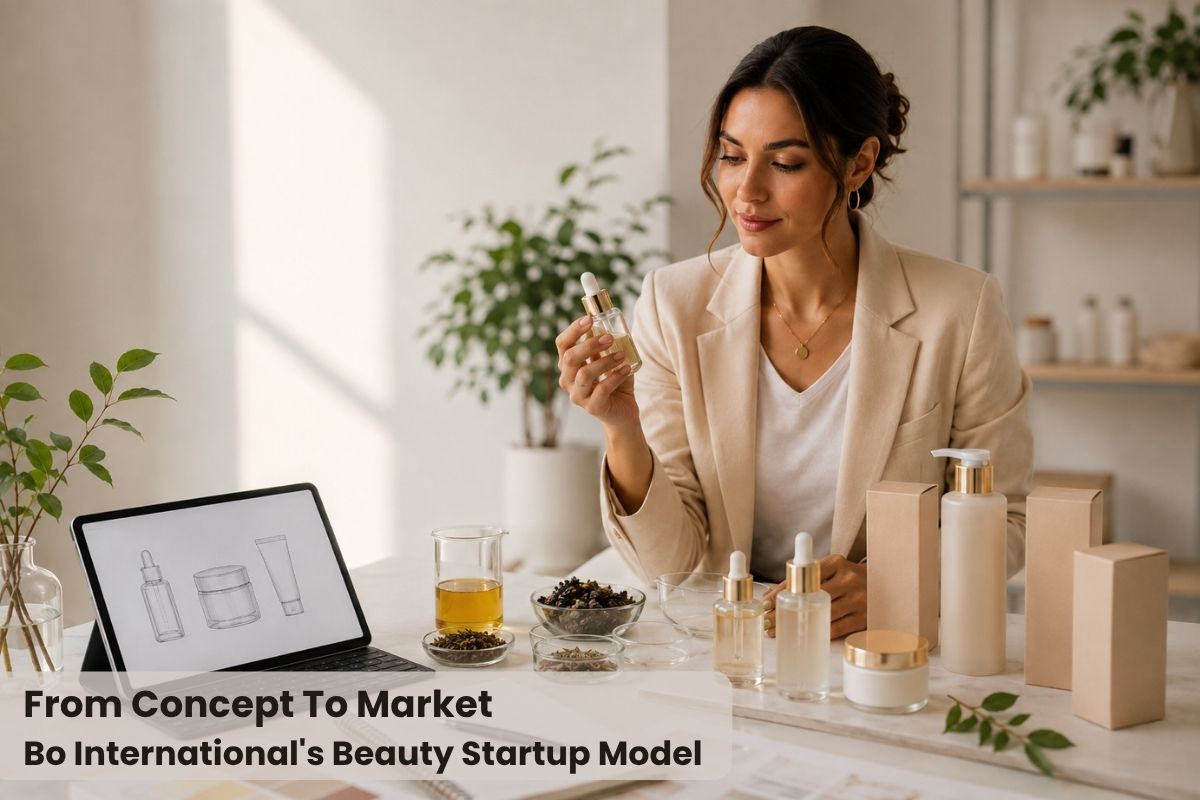
Beauty entrepreneurs typically take a long time pondering what they would like to market.
Perhaps it’s a lightweight cosmetic serum, a sulfate-free shampoo, a body-care collection, or an exclusive fragrance line.
The more difficult problem is how will this idea be made into a reliable product that is able to be manufactured on a large industrial scale?
The formula has to go beyond a single test.
Ingredients need to be chosen in a way that is appropriate, the product must have the appropriate texture and the user experience.
Packaging must be practical, and the manufacturing must be constant as the order volume increases.
This is the reason that entrepreneurs often decide to partner with an independent cosmetics manufacturer rather than investing in their own manufacturing facility.
Turning the Concept Into a Workable Formulation
Product formulation is the point where an idea is first made real.
A founder might have an idea of the kind of experience they wish to achieve, a moisturizing lotion with a smooth finish for instance, but not being aware of the precise combination of ingredients needed to create it.
Bo International offers private label cosmetic third party manufacturing support via the company’s research and development capability.
According to Bo International, formulations can be created by modifying existing base formulations or formulated in accordance with specific requirements for the product as well as budgetary requirements.
This is particularly important for companies that are just starting out because the formula has an impact on more than the ingredients list.
Color, texture, smell and application, compatibility with packaging and the overall experience for customers influence the way a product’s beauty is perceived.
Sampling Before Moving Into Production
Making the leap from an idea to a huge manufacturing order can lead to an unnecessary risk.
Sampling provides a beauty brand an opportunity to test the product prior to committing to commercial production.
It is possible to answer questions early:
- Do you feel the textures are comfortable?
- Do you think the fragrance is appropriate for the intended buyer?
- Does the product align with the brand’s message?
- Do you have anything to change prior to production?
Bo International lists product sampling as one of the phases in its manufacturing process prior to packaging and production.
In the case of a start-up this isn’t just an opportunity to manufacture.
It’s an opportunity for better company choices prior to committing more funds and inventory is placed in the hands of.
Moving From Samples to Commercial Manufacturing

After the direction of the product has been determined The next step is to produce it consistently.
The establishment of a separate cosmetic manufacturing company requires production space, equipment and technical know-how, as well as people as well as processes and quality control.
It may be an appropriate investment for established companies but it’s challenging to prove the value for a start-up beauty business that is just beginning to test the market.
Manufacturing by third parties is an alternative option.
Instead of owning the manufacturing facility, the entrepreneur is focused on creating the business, while the manufacturing partner oversees the manufacturing.
Bo International provides private label and contract manufacturing in various categories like private label skincare, haircare, grooming, personal care and various other beauty products.
This can enable an entrepreneur to focus more on areas such as positioning, customer acquisition distribution, content and sales.
Packaging Is Part of the Product Strategy
Beauty products are not completed until their formulation is completed.
Packaging can have a direct impact on how the customer experiences and comprehends the product.
The best serums in poor packaging, for instance, can cause confusion between the product’s formula and the brand’s positioning.
Therefore, founders need to be able to think beyond appearance.
The packaging choices should take into consideration:
- the nature and consistency of the formulation;
- the ease of application of products;
- customer expectations;
- visual brand identity of the company;
- The practicality of the shipping and storage process;
- the overall market situation of the product’s overall market position.
Bo International incorporates customized packaging in their private label or contract manufacturing capabilities that allow the development of products and packaging to be considered as part of the same process.
Scaling Without Building Everything Yourself
Outsourcing manufacturing is not the same as outsourcing your business.
The founders must still understand the people they’re selling their products to, why consumers are supposed to choose their product and what they should be priced, and where the products will go as well as how their brand can generate repeat sales.
What manufacturing partners can accomplish is reduce the operational complexity involved in the decision making process and turn them into physical products.
Bo International’s process is described as moving through the selection of products, sample production, packaging and distribution and finally, shipping.
Entrepreneurs, this larger idea is important: startups do not have to control every aspect of the value chain.
Successful companies often recognize the areas where their expertise can create the most value and specialists can offer infrastructure, technical expertise or increase scale.
What Beauty Entrepreneurs Can Learn From This Model
The path from idea to product to a brand name for beauty becomes much simpler to manage if founders break it down into stages instead of trying to tackle all of the issues all at once.
Start with the client and the issue the product is designed to solve. Create a clear concept for the product.
Develop the formulation and test it carefully.
Be aware of packaging before it is ready.
Learn about the manufacturing requirements prior to making a decision to launch.
Choose partners not just on their production capabilities but also on how they will be able to help in the direction that the brand plans to expand.
For new beauty companies collaboration with companies like Bo International demonstrates how private label manufacturing and third-party manufacturing can bring innovative ideas for products to the necessary infrastructure to transform into commercially-available products.
Final Thoughts: Build a Beauty Brand That Can Grow With You
Starting a beauty brand is rarely only about selling skincare, haircare, or personal care products.
For many founders, the deeper goal is to create financial independence, solve a problem they understand personally, express an original point of view, and build something they can genuinely call their own.
A strong manufacturing partnership can give a founder:
- More time to understand customers and develop the brand;
- Access to formulation, testing, production, and quality-control capabilities;
- A clearer path from initial samples to commercial quantities;
- Greater confidence when approaching retailers, investors, and distributors;
- Infrastructure that can support new products and future growth;
- Less pressure to build an expensive laboratory or factory from the beginning.
However, a manufacturer cannot replace customer research, regulatory responsibility, brand positioning, or demand.
The founder must still define who the product serves, which problem it solves, why customers should trust it, and whether the business can remain profitable after production, packaging, shipping, marketing, and returns.
The founder remains the owner of the vision.
The right partner simply makes that vision safer to develop, more consistent to manufacture, and easier to scale.
Years from now, the real achievement will not be seeing one attractive product on a shelf.
It will be knowing that an idea once held privately became a trusted part of customers’ routines, and a sustainable business capable of supporting your creativity, independence, and future.