
Engagement Ring Insurance: What It Covers and How to Protect Your Ring
✨ Key Points
- Homeowners insurance may cover an engagement ring, but usually with limits. Standard policies often include jewelry under personal property coverage, while theft may be subject to a separate, lower coverage limit.
- Homeowners insurance does not automatically cover every way a ring can disappear. Accidental loss, mysterious disappearance, or certain types of damage may not be covered unless additional jewelry coverage is added.
- You can add engagement ring coverage to a homeowners policy or buy separate jewelry insurance. Scheduling the ring on your existing policy or choosing a standalone policy can provide broader protection based on the ring’s value and your coverage needs.
An engagement ring can be one of the smallest valuables you own, and one of the easiest to lose or damage.
In fact, more than half of jewelry owners surveyed by Jewelers Mutual said they had lost at least one piece of jewelry in the past.
The financial gap can be significant.
Standard homeowners policies commonly have a jewelry theft limit of around $1,500, according to the Insurance Information Institute.
Meanwhile, Jewelers Mutual reports that 66% of surveyed consumers said they would struggle to pay for a replacement engagement ring if theirs were lost, stolen, or damaged.
That makes checking your coverage before something happens particularly important.
Look at:
- Your policy’s jewelry coverage limit;
- Whether accidental loss, theft, damage, and unexplained disappearance are covered;
- Whether your ring needs to be scheduled separately or covered by dedicated jewelry insurance;
- What appraisal, receipt, or other documentation you would need to make a claim.
A ring being listed under homeowners or renters insurance does not necessarily mean its full value, or every way it could be lost—is covered.
en minutes spent checking the details now could prevent a much more expensive surprise later.
The clause that catches everybody
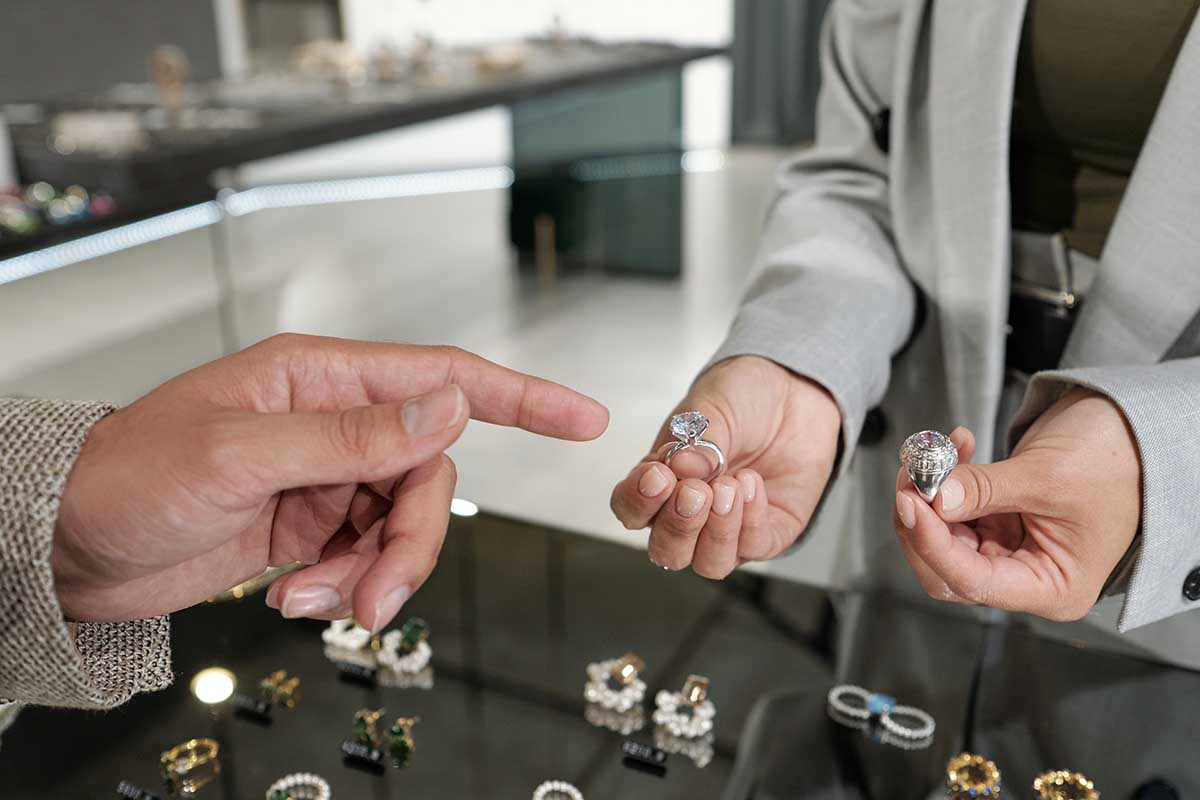
Young woman holding two engagement rings over display while male client pointing at one of them while choosing jewelry
Standard home and contents policies cover the contents of you
r home, including jewellery, up to the overall sum insured.
But almost all of them apply a separate per-item limit to valuables.
That limit is typically modest, and any single item worth more than it is covered only up to that limit, regardless of the total sum insured on the policy.
So a household with a generous contents figure can still have an engagement ring covered for a fraction of its value, because the ring exceeds the per-item cap on its own.
The fix is to specify the item, sometimes called scheduling or listing it.
That means naming it individually on the policy with its own sum insured.
It costs a little more in premium and it is the difference between insured and not.
Check your policy schedule for the per-item limit on valuables.
If your ring is worth more than that number and is not listed individually, it is not properly covered.
The valuation and why a certificate will not do
Insurers want a vrt from a laboratory like GIA describes the stone.
Carat weight, colour, clarity, cut, measurements, proportions, treatments, sometimes a laser inscription number.
It says nothing about money.
aluation, and people routinely supply the wrong document.
- A grading repoA valuation is a separate document produced by a qualified valuer stating what it would cost to replace the piece. That is the number an insurer is underwriting. You need both. The report substantiates the stone, the valuation establishes replacement cost.
- Update it every few years. Metal prices move, diamond prices move, and manufacturing costs move. A ring valued in 2019 is almost certainly underinsured now.
That point is more urgent than usual for Australian households holding pink diamonds.
The Argyle mine in Western Australia produced more than 90 per cent of the world’s pink diamonds before closing permanently in November 2020, and Rio Tinto’s final inventory tender concluded in October 2025.
Supply is now fixed, appreciation has run at roughly 8 to 12 per cent a year since closure, and stones with verified Argyle provenance carry a 20 to 50 per cent premium over comparable pinks.
Different engagement ring styles featuring Argyle diamonds may have increased in value since the mine closed in 2020, meaning pieces valued before then could now be substantially underinsured.
Specified cover versus standalone jewellery insurance
Two routes, with real differences.
Extending your home and contents policy by specifying the item is the common approach. It is straightforward, the premium is modest, and everything sits with one insurer.
The drawbacks are that a claim affects the claims history on your whole policy, excesses are usually set at the household level, and cover away from home varies considerably.
A standalone specialist jewellery policy is written specifically for the item. These typically offer worldwide cover, lower or nil excesses, and terms designed around how jewellery is actually lost rather than around household risk.
They cost more. For a very valuable piece, or for someone who travels frequently, they are often the better arrangement.
The words that decide your claim
Policy language in this area is not standardised, and small differences matter enormously.
Theft means taken by another person. Almost always covered.
Accidental loss means you lost it. This is how most rings actually disappear, and it is the one that varies most between policies. Some cover it, some cover it only away from home, and some exclude it entirely. Check specifically for the words accidental loss rather than assuming theft cover is enough.
Mysterious disappearance describes an item that is simply gone with no explanation. Some policies exclude it outright.
- Accidental damage covers a bent band or a chipped stone. Frequently excluded from basic policies.
- Loss of stone from setting. This is the significant one. Many policies will not pay where a stone has fallen out due to a worn setting, because that is classified as wear and tear rather than an insured event. Some cover it only if there was an identifiable impact. This is precisely why annual claw checks matter. A worn claw is a maintenance issue your insurer may decline, and a stone lost that way is your loss.
- Wear and tear is excluded from every policy. Nobody insures gradual deterioration.
- Pairs and sets. If you lose one earring, does the policy pay for the pair or for the single? Relevant to matched wedding sets.
Away from home and overseas
Most rings that go missing do so away from the house, so the geographic terms matter more than the household ones.
Some contents policies extend to personal effects away from home automatically.
Some require an additional option.
Some limit it to Australia, some include worldwide travel, and some cap the overseas period at a set number of days.
A few impose conditions that catch people out, such as requiring valuables to be carried on the person rather than left in accommodation, or excluding items left in a vehicle.
If you are travelling with a ring, read this section before you fly rather than afterwards.
What actually happens at a claim
Understanding the process explains why documentation matters so much.
- You report it, usually within a stated window, which can be as short as a few days. Report promptly even if you are unsure.
- A police report is required for theft, and for loss in many policies. If it happened overseas, you must file in that jurisdiction before you come home, because obtaining a report afterwards is extremely difficult.
- The insurer assesses, using your valuation, the grading report and photographs.
- Then replacement. Most jewellery policies are replacement rather than cash settlement. The insurer arranges a like-for-like replacement, frequently through their own preferred supplier, rather than handing you the money.
That last point surprises people and it is worth asking about in advance.
If you want the replacement made by the studio that made the original, check whether the policy allows you to nominate your own jeweller.
Some do, some pay a cash equivalent based on their supplier’s pricing, and some insist on their own channel.
For a ring made to a specific design, that difference is significant, because a generic replacement of equivalent specification is not the same object.
The documentation to have ready
Assemble this once and store it somewhere reachable without the physical items.
- The valuation, current within a few years.
- The grading report, with the number recorded separately.
- The original receipt.
- Photographs. Front, back, side and on the hand, in good light. Photographs are what allow an insurer to replace something accurately.
- Any Argyle or coloured stone certification, including the lot number and inscription details.
Keep copies in cloud storage as well as at home. A house fire that takes the ring usually takes the paperwork with it.
Underinsurance and the averaging clause
A trap worth understanding, because it can reduce a payout on a claim you thought was fully covered.
Many contents policies contain an averaging or co-insurance provision.
If the total sum insured is materially below the actual replacement value of your contents, the insurer may reduce a claim proportionally, even a partial one.
In practice that means a household that has not reviewed its contents figure in a decade, and has accumulated jewellery, electronics and furniture in that time, can find a claim settled at less than the loss because the policy as a whole was underinsured.
Specified items are usually assessed separately and are therefore less exposed to this, which is another argument for listing a ring individually rather than relying on the general contents figure.
Review the total sum insured at the same time you review the ring. Both drift.
When the ring is not yours yet
A timing gap that catches a surprising number of people.
A ring collected from a jeweller on a Friday for a weekend proposal is typically not on anybody’s policy.
The jeweller’s cover ended when it left the shop.
The recipient’s cover has not started because they do not own it and do not know about it.
The buyer’s policy may not list it.
Insurers do not always add a specified item instantly either.
Some require the valuation to be reviewed, and a few days between submitting documents and cover taking effect is normal.
The practical answer is to arrange cover in the buyer’s name before collection, with the valuation supplied in advance, and to transfer or re-specify it afterwards.
Most insurers handle this routinely if you explain the situation.
The same gap exists in reverse after an engagement, when the ring changes hands but the policy still names the buyer. Worth a phone call.
Reducing the premium and the risk
- Wear it less in high-risk situations. Not romantic, and it is the single most effective loss prevention. Off for the gym, gardening, the beach and cold water, where fingers shrink and rings slide off unnoticed.
- Have the setting checked annually. A retipped claw costs very little. A stone lost to a worn claw may not be covered at all.
- Store it properly when not worn, in one consistent place. More rings are lost in transit between hand and safe place than while being worn.
- Ask about security discounts. Alarms and safes reduce premiums with some insurers.
- Consider the excess. A higher excess lowers the premium, and on a ring you would only claim for in a total loss that can be a sensible trade.
The conversation to have with your jeweller
Two things a good jeweller will help with.
They can arrange or recommend an independent valuation, and some include one with a new piece. Ask whether the valuation is independent, because a valuation from the seller is acceptable to many insurers but not all.
They can also tell you the replacement position: whether the design could be remade, whether the stone is readily matchable, and what documentation exists.
That matters most for bespoke work, where a like-for-like replacement depends on the maker still having the design files and specifications.
Studios that design and manufacture in house, Stelios Jewellers among the Australian ones, typically retain the computer models and stone details for pieces they have made, which makes accurate replacement possible rather than approximate.
Worth asking before you need it.
Renters and share houses
Often overlooked, and the exposure is higher rather than lower.
Renters need contents insurance in their own name, because a landlord’s building policy covers the building and nothing inside it.
A great many people in rented accommodation carry no contents cover at all and therefore no jewellery cover.
In a share house, standard contents policies frequently contain conditions about forcible entry, or exclude theft by a person lawfully on the premises, which covers a surprising range of situations involving housemates and their visitors.
If you are renting and own a ring of any value, a standalone specialist jewellery policy is often simpler than trying to make a contents policy fit, because it follows the item rather than the address.
A note on second-hand and inherited pieces
Inherited jewellery is the most consistently uninsured category in Australian households.
The usual pattern is that a piece arrives through an estate, goes into a drawer, and never touches a policy because nobody thinks of it as a purchase.
If it is worn even occasionally, it needs listing, and listing requires a valuation.
Inherited pieces also frequently carry no documentation at all, which makes a valuation harder and more important.
A valuer will assess the stones and construction directly, and for an older piece this quite often reveals something worth considerably more than the family assumed.
The five minute audit
Do this today.
Find the per-item limit for valuables on your contents policy. It will be in the schedule.
Compare it with what your ring is worth. If the ring is higher, it is not adequately covered.
Check whether accidental loss is included, not just theft.
Check the away-from-home and overseas terms.
Check when your valuation was written. If it predates 2020, get it redone.
Most people who do this discover at least one gap, and every one of them is straightforward to fix while nothing has gone wrong.
This article is general information only and is not insurance advice. Policy terms vary significantly between insurers and products. Read your product disclosure statement and confirm cover with your insurer.