
Modern Invitation Etiquette: 6 Common Invitation Card Mistakes to Avoid
✨ Key Points
- Include every essential detail: State the occasion, date, time, complete location, dress code, and RSVP instructions clearly.
- Clarify exactly who is invited: Address guests accurately and specify plus-ones, partners, and children to prevent uncomfortable assumptions.
- Make responding simple: Provide one reliable RSVP method, a realistic deadline, and contact information for accessibility or dietary questions.
An invitation is more than a decorative announcement.
It gives guests the information they need to decide, plan, respond, and arrive confidently.
Missing or unclear details can lead to repeated questions, late arrivals, incorrect assumptions about who is invited, and unnecessary stress for the host.
A well-designed invitation should make these details immediately clear:
- What the event is celebrating;
- Who is hosting;
- Date and start time;
- Venue name and complete address;
- Who is included in the invitation;
- Dress code, when relevant;
- RSVP deadline and response method;
- Essential accessibility, parking, or travel information.
These principles apply to wedding and engagement invitations, birthdays, graduations, corporate events, and retirement party invitations.
Printed and digital invitations can both work well.
The best format is the one your guests can receive, understand, and respond to easily.
Before sending yours, review these six common invitation-card mistakes so the first impression of your event feels thoughtful rather than confusing.
How to Design an Invitation Card Properly
You can create an invitation yourself or hire a professional designer.
What matters most is not design experience, it is whether guests can read, understand, and respond to the invitation easily.
Before printing or sending it, check:
- Names, spelling, date, time, and venue address;
- Clear visual hierarchy and readable font sizes;
- Strong contrast between the text and background;
- Consistent colors, spacing, and alignment;
- RSVP method and deadline;
- Correct QR codes, links, email addresses, and phone numbers;
- Wording that clearly identifies who is invited;
- Print quality, paper size, and envelope fit.
Ask at least two other people to proofread the final version.
One should review the wording, while the other should follow the invitation as though they were a guest, checking the map, scanning the QR code, and testing the RSVP process.
A beautiful invitation creates excitement, but a useful one prevents confusion.
The following common invitation-card mistakes can help you identify problems before they reach your guests.
Mistake: Starting the Invitation Design Too Late
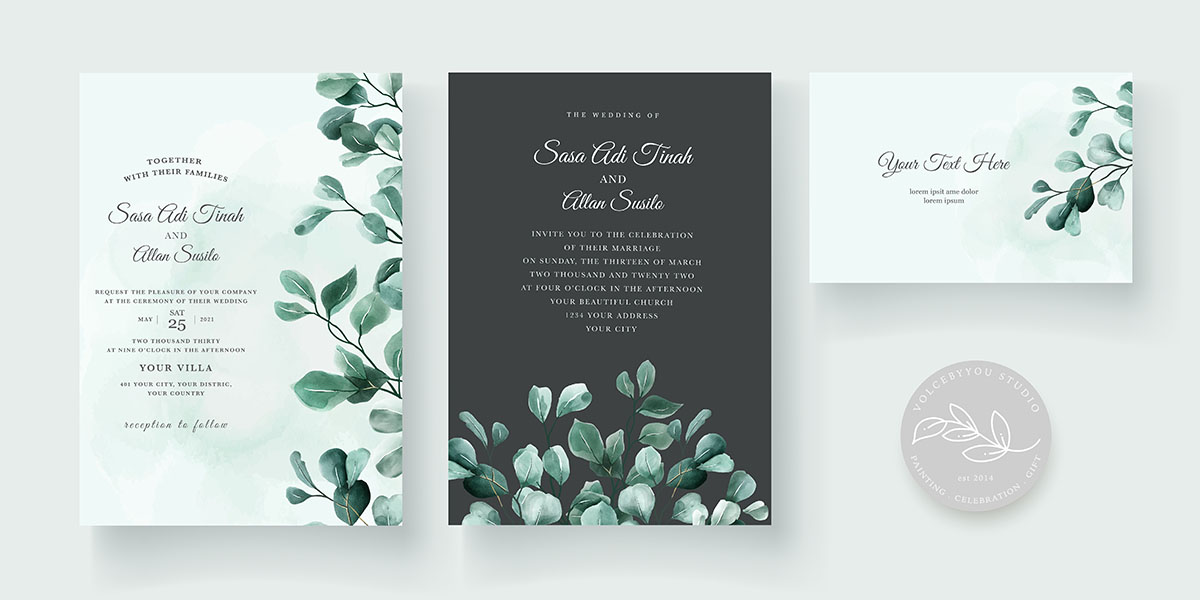
Even an experienced designer needs time to create, revise, proof, print, and deliver an invitation.
A rushed process can lead to spelling errors, unreadable typography, incorrect colors, printing problems, or invitations reaching guests too late.
Plan backward from the date guests must receive the invitation, not from the event itself.
Allow time for:
- Confirming the guest list and event details;
- Selecting the theme, colors, fonts, and illustrations;
- Reviewing design proofs and making revisions;
- Printing a physical sample;
- Correcting production errors;
- Addressing envelopes and arranging postage;
- Replacing invitations lost or damaged in transit.
One month before the event may be far too late, especially for weddings, destination celebrations, or custom-printed stationery.
Begin as soon as the venue and date are confirmed, then build extra time into the schedule.
Finishing early does more than improve the design.
It gives guests enough time to make travel arrangements, respond by the deadline, and look forward to the event without feeling rushed.
Mistake: Choosing the Wrong Color or Theme
You might think that every color of the invitation card is suitable for each event, but that is not the case.
Understanding color palettes is essential if you are designing your card or directing a card maker.
Bright colors work well with invitation cards for events like birthday parties or graduation parties, but wedding and engagement cards have a softer color scheme.
Birthday party cards, even for adults, need to have a brighter and cheery look.
It does not matter if you are designing your 70th birthday party invitations.
It is still the event full of joy.
Mistake: Grammatical and Spelling Errors

Spelling or grammar mistakes can make an invitation appear careless, but the greater risk is practical confusion.
An incorrect name, date, address, or RSVP detail could prevent a guest from responding or arriving correctly.
Before sending or printing the invitation:
- Run a spelling and grammar check;
- Verify every guest, host, and venue name;
- Confirm that the date matches the correct day of the week;
- Check the time, address, postal code, and RSVP deadline;
- Read the wording aloud to identify awkward sentences;
- Ask at least two other people to proofread it;
- Review a printed proof because errors may be easier to notice on paper.
Do not rely entirely on automated tools.
They may miss correctly spelled words used in the wrong context or “correct” an unusual name incorrectly.
Approve the final invitation only after comparing every important detail with the venue contract, calendar, and guest list.
A few extra minutes of verification can prevent expensive reprinting and unnecessary confusion.
Mistake: Incorrect Time and Date
Mentioning the correct time and date on your card is very important.
Avoid writing an early time for your event, especially in wedding card invitations.
Guests generally arrive an hour or a half before the wedding reception, so an early time can create trouble for you and bore your guests.
Double-checking all the information is crucial as the misspelled or incorrect date can ruin your event.
Your event is important to you, so avoid ruining it by making these silly mistakes.
Mistake: Writing Inaccurate Guest Names

Your guests are the most important part of your event.
Try not to offend them. Sometimes you mistakenly write the incorrect spelling of the guest’s name that can offend them.
You do not want to invite Hane instead of Jane.
This may sound like a very little thing to get your feelings hurt, but some people are very particular about spelling their names.
You also must be very clear about who you are inviting.
If you want to invite Mr. Davis’s whole family, you must write the Family of Mr. Davis and not Mr. and Mrs. Davis.
Mistake: Writing an Incorrect or Incomplete Address
Even a beautifully designed invitation fails if guests cannot find the venue.
An incomplete address or inaccurate map pin can cause late arrivals, missed ceremonies, and repeated calls to the host.
Include:
- Venue name;
- Building or street number;
- Complete street address;
- City, state or region, and postal code;
- Room, floor, or suite number when relevant;
- Correct entrance and parking instructions;
- Accessibility or public-transport details when helpful.
For printed invitations, add a short map link or QR code leading to verified directions.
A map can also appear on a separate details card or the event website.
Before sending the invitations, test the address in multiple navigation apps and ask someone unfamiliar with the venue to follow the directions.
If the map pin leads to the wrong entrance, provide a corrected pin and clear written instructions rather than relying on the street address alone.