How Aerial Perspectives Inspire Breathtaking Modern Illustrations
✨ Key Points
- Aerial perspective helps artists create depth by mimicking how distant objects fade and turn bluish in the atmosphere.
- Many digital illustrators travel or fly to capture real sky views, using photos of clouds, light, and landscapes as creative references.
- By blending real-world observation with digital tools, artists create fantasy worlds that still feel believable and immersive.
The world of digital illustration is currently experiencing a spectacular renaissance of atmospheric, dreamy landscapes.
If you scroll through any online portfolio or modern art blog today, you will likely spot sweeping cloudscapes, dramatic lighting, and floating cities suspended in pastel skies.
While these mesmerising artworks are crafted on glowing screens using advanced software, their roots are firmly planted in the physical world.
Artists constantly seek out the vastness of the sky and the unpredictability of nature to fuel their creative visions.
This proves that sometimes the best way to design an entirely new world is to step away from the desk and look down at our own environment from a great height.
To truly understand the magic behind these digital creations, we must explore how real-world experiences translate into breathtaking visual art.
The Science Behind the Scenery
When illustrators set out to create vast, believable distances in their work, they rely on a powerful concept known as aerial perspective.
This technique is not just a clever artistic trick but a physical reality of how our human eyes perceive light, space, and distance.
According to educational resources from the Hanover College Psychology Department, atmospheric light scattering is the key to this visual phenomenon.
The scattering of short blue wavelengths by atmospheric particles ensures that distant objects lose texture and take on a bluish hue.
By understanding this core physics principle, artists can deliberately recreate these hazy, blue gradients to force a perception of vast depth on a two-dimensional canvas.
Mastering this delicate balance of colour and light is what separates a flat, lifeless image from an immersive, breathtaking world that viewers feel they could step right into.
Historically, traditional painters used these same principles, but modern digital artists are taking the concept to new heights by applying these rules to fantastical science fiction and fantasy environments.
These creators meticulously study how humidity and dust particles alter visibility, ensuring their imaginary worlds feel grounded in authentic atmospheric science.
Chasing the Horizon: Gathering Real-World Reference
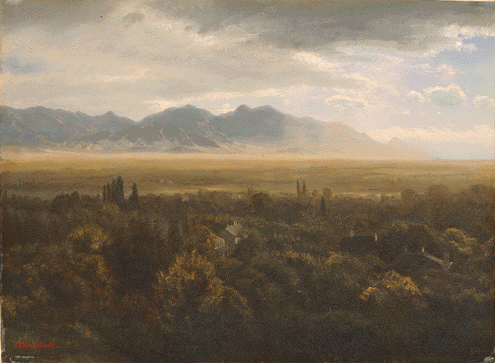
To capture the true nuances of aerial perspective, many contemporary artists find that standard stock photos simply do not provide the necessary depth or emotional resonance.
Instead, they actively seek out first-hand travel experiences.
Illustrators looking for authentic reference material for lighting and scale often book flights with Floating Images to capture their own breathtaking reference photos from above.
Experiencing the sheer, unadulterated scale of the earth from a high vantage point allows creators to observe exactly how sunlight interacts with the atmosphere in real time.
It is a sensory experience that informs their art just as much as the visual data they collect.
When artists take to the skies for creative research, they typically capture specific elements for their reference libraries:
- Dynamic Lighting: Observing how the sun peeks through varied cloud layers at dawn or dusk creates an invaluable reference for dramatic, natural contrast.
- Scale and Proportion: Seeing physical landscapes shrink to miniature proportions helps illustrators understand how to map out vast fictional cities or alien terrains.
- Colour Transitions: Documenting the exact, subtle gradients where the warm golden glow of the sun meets the cool, crisp blue of the upper atmosphere.
- Cloud Architecture: Studying the volumetric, three-dimensional shapes of cumulus or cirrus clouds allows artists to render them accurately rather than relying on generic, flat brush stamps.
Translating the Sky to the Screen
Once the physical journey ends, the meticulous digital translation begins.
Artists return to their studios with memory cards full of vibrant, high-altitude reference photos.
These personal images become the ultimate muse, guiding the overarching colour palettes and specific lighting choices for their next major project.
As graphic designer Carlos Alberto Salvá highlighted when discussing how to use a Wacom Bamboo Tablet to create a digital masterpiece, transitioning traditional techniques and real-world muses into the digital realm requires a strong willingness to experiment.
Illustrators will often lay their high-altitude reference photos directly next to their active digital canvas.
This allows them to extract exact colour codes, study the diffusion of light, or understand how a shadow falls across a complex, fluffy cloud formation.
By bridging the gap between raw, atmospheric photography and modern illustration software, these creators can produce works that feel incredibly fantastical yet deeply grounded in physical reality.
They utilise layering techniques, custom brushes, and blending modes to mimic the soft, atmospheric haze they witnessed from their aerial vantage points.
The Continuing Cycle of Inspiration
The beautiful intersection of travel, photography, and digital art proves that modern technology does not have to isolate creators from the natural world.
Instead, it provides an innovative new medium to celebrate it.
By studying the precise science of atmospheric light scattering, taking to the skies for highly original reference material, and applying those practical lessons through advanced drawing tablets, today’s modern illustrators continue to push the boundaries of visual storytelling.
As software becomes more sophisticated, the importance of grounding digital tools in real-life experiences will only grow.
The next time you find yourself admiring a mesmerising piece of digital art featuring an endless glowing horizon, take a moment to appreciate the journey behind it.
Remember that the artwork likely started with an artist simply looking out at the vast sky and making the conscious decision to capture its magic.