Why Luxury Fashion Might Be Losing Its Power in 2026–2027
✨Key Points
The Storytelling Parity: Mass-market brands have mastered the emotional language — purpose, identity, and community — that was once the exclusive domain of luxury houses. This shift has become one of the key drivers behind the luxury fashion vrisis 2026.
The Heritage Devaluation: For Gen Z and Alpha, “100 years of history” is less persuasive than “cultural relevance today.” Legacy is being replaced by active, real-time engagement.
Confidence over Logos: A cultural shift is moving status away from visible branding toward “Quiet Status”—where wearing a no-name brand with confidence signals more power than a head-to-toe logo.
Why Mass Market Branding Is Winning in 2026
For decades luxury brands had one powerful advantage. They did not simply sell clothing. They sold identity.
Luxury represented a certain vision of life.
When people bought luxury pieces, they were not simply purchasing a jacket or a handbag; they were buying a feeling, a sense of identity, and a position in the world that defined traditional luxury consumer behavior.
Luxury symbolized:
aspiration;
belonging;
status;
access to a certain world.
Mass-market brands, on the other hand, used to focus mainly on the product itself.
A T-shirt was simply a T-shirt, and a pair of sneakers was just another pair of sneakers.
The emotional layer was usually missing, which makes their transformation today one of the key forces behind the luxury fashion crisis 2026.
But over the past decade something important changed. Mass-market brands quietly learned how to build emotional branding, and this shift has become one of the key forces behind the luxury fashion crisis 2026.
They began telling stories that people could connect with, stories about identity, culture, and shared experiences.
Many of these brands started building narratives around:
- community
- identity
- purpose
- culture
- lifestyle
They also learned how to deliver these stories through modern platforms. Social media, creators, and online communities became the new stage for fashion storytelling.
This shift helped fuel what many analysts now describe as community-led fashion movements, where people do not just buy products but feel part of a shared culture.
In other words, mass-market brands learned to speak the same emotional language that luxury brands had dominated for decades.
But they added something luxury often could not offer.
Accessibility.
When emotional storytelling meets accessible pricing, it changes how people evaluate value. Consumers begin to compare the emotional experience of a product with its actual cost.
And that comparison leads to a question that many luxury brands now face as part of Luxury brand crisis management 2026:
If two brands can tell compelling stories and create cultural relevance, why should someone pay ten times more for one of them?
The Death of the Legacy Logo
Several cultural shifts have been building quietly for years.
Together they created what many analysts now call the luxury fashion slowdown of 2026–2027.
Heritage Brands Became Overvalued
For decades luxury brands relied on their history. Some fashion houses proudly highlight that they have existed for eighty or even one hundred years.
However, younger consumers today are far less impressed by legacy alone, which is becoming a central factor in the changing future of luxury consumer behavior.
They ask a simpler question:
Is this brand culturally interesting right now?
And sometimes the answer is unclear.
Logomania Is Losing Its Power
There was a time when wearing a giant logo meant status. Today it often feels like a billboard.
Many consumers now prefer quiet status symbols subtle pieces that only insiders recognize.
This “if you know, you know” style is replacing loud luxury branding.
Conscious Consumption Is Rising
Another major shift is conscious consumption.
People increasingly think about:
- sustainability;
- ethical production;
- intentional purchases.
Luxury brands should benefit from this shift toward more conscious consumption, but many of them still struggle to align their messaging and brand values with modern expectations, which is becoming a key challenge within the luxury fashion crisis 2026.
Loyalty to Fashion Houses Is Declining
The fashion world used to revolve around a small circle of iconic houses. Today loyalty is weaker. Consumers explore constantly. New brands appear every year and quickly gain global attention.
The hierarchy that once defined fashion is becoming far more fluid.
The Evolution of Status: 2016 vs 2026
The meaning of status itself has changed.
| Feature | Old Luxury (2016) | New Status (2026) |
|---|---|---|
| Primary Value | Exclusivity & High Price | Community & Shared Values |
| Symbol | Large Logos (Logomania) | Quiet Signals (IYKYK) |
| Messenger | A-List Celebrities | Creators & Communities |
| Speed | Seasonal collections | Culture-driven, real-time |
In short, status used to come from price. Now it increasingly comes from cultural relevance.
The Cultural Flip: Simplicity Became the New Luxury
Think about Steve Jobs for a moment.
His black turtleneck became iconic not because it was expensive, but because it represented independence, focus, and a clear personal identity.
That idea quietly influenced culture.
Today you can see the same shift happening in fashion.
Celebrities and wealthy individuals increasingly wear pieces from independent or lesser-known brands instead of obvious luxury labels.
And interestingly, this sends a powerful message.
It signals confidence. It communicates a simple idea: “I do not need a logo to prove anything.”
At the same time, wearing luxury logos from head to toe can sometimes feel outdated.
Not always, of course. But often enough that it clearly signals a cultural shift.
Case Study: Why Community Brands Are Growing Faster
Several modern brands illustrate how this new model works.
Gymshark’s Community Strategy
Gymshark did not grow simply because it sells leggings. The real reason behind its success is community.
A great example is the Gymshark 66 challenge.
Participants commit to building a new habit over sixty-six days while sharing their progress online with others who are on the same journey.
The experience creates accountability, encouragement, and a sense of belonging.
In that moment the brand becomes more than a product.
Gymshark becomes part of a personal transformation.
What begins as a purchase turns into a shared experience, and the brand shifts from a simple transaction to a community-led fashion movement.
Nude Project and Creator Culture
Another example is Nude Project.
Instead of traditional fashion marketing, the brand built its identity around creators and cultural storytelling.
Their messaging feels like belonging to a creative collective rather than buying clothing.
This is the essence of community-based fashion brands.
And it’s extremely powerful.
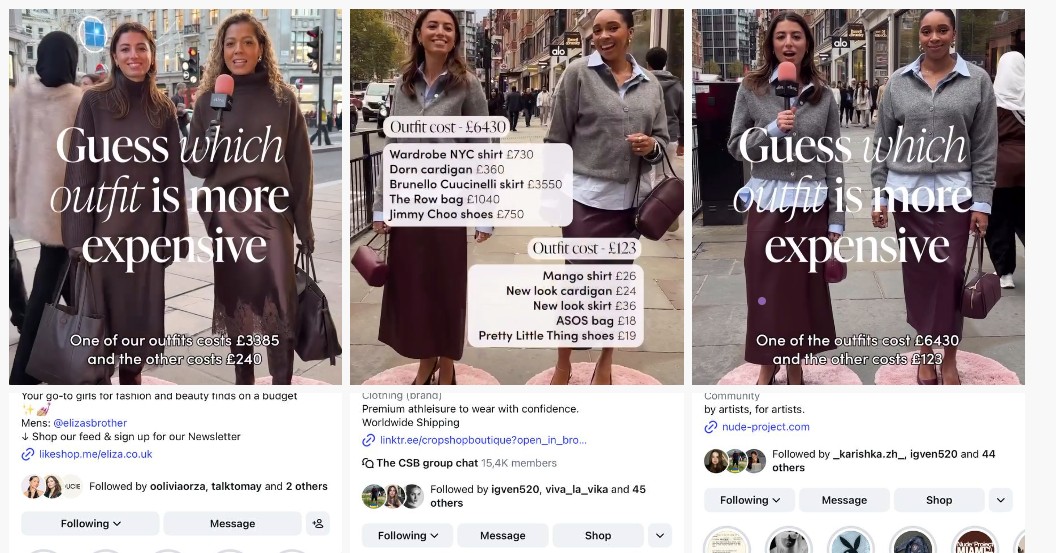
The Experiment That Reveals the Shift
There’s a popular street experiment circulating online. People are shown two outfits:
one from a luxury brand;
one from a newer independent label;
Pedestrians are asked:
Which one is more expensive?
Most people guess wrong.
And honestly, that is not surprising.
Luxury items rarely cost more because of materials alone.
In many cases the fabrics and manufacturing quality are very similar to what you can find in high-quality mass-market brands.
For a long time, what justified luxury pricing was something less tangible: the story, the emotion, and the mythology around the brand.
Today that advantage is no longer exclusive.
Many younger brands are learning how to tell stronger and more engaging stories through digital-first fashion storytelling, and as a result the visual and emotional difference between luxury and well-built mass-market brands is becoming harder to recognize.
The Creator Economy Parallel
This shift reminds me of something happening with creators and bloggers.
Some established influencers believe their position is permanent.
They assume their audience will stay forever.
So they continue doing things the same way.
Meanwhile younger creators enter the same competitive platforms — Instagram, TikTok, YouTube.
The ones who succeed understand how the ecosystem works today.
They know:
how to position themselves;
how to build community;
how to create content that resonates;
The fashion industry is experiencing the exact same dynamic.