Why Cross Stitch Is Perfect for Beginners
✨Key Points
- Cross stitch gives beginners a clear roadmap: The chart determines where each stitch and color belongs, reducing creative uncertainty.
- Progress is visible quickly: Even a short stitching session adds a recognizable section, creating motivation to continue.
- The right first project matters: A small pattern with fewer colors is easier to finish than a large, highly detailed design.
Everyone has a drawer filled with abandoned hobbies.
Mine contains half a scarf, a bag of yarn I loved for exactly one week, and a watercolor set I used twice.
Craft stores are remarkably good at selling us the fantasy of a new hobby—and sometimes the guilt that remains when we abandon it.
Cross stitch is different. It is one of the few crafts beginners can start without expensive equipment, artistic experience, or a dedicated workspace.
A pattern tells you where every color belongs, the repeated stitches are easy to learn, and visible progress begins almost immediately.
That structure matters. Most beginners do not quit because they lack talent.
They quit because a hobby demands too many decisions, costs more than expected, or takes too long to produce a satisfying result. Cross stitch for beginners removes many of those barriers:
- The pattern provides clear instructions.
- The basic stitch is simple and repeatable.
- Small projects can show progress during the first session.
- Supplies are affordable and easy to store.
- The finished size and stitch count can be checked before starting.
- Mistakes can usually be removed and corrected.
The biggest threat to finishing is not ability, it is choosing a first pattern that is too large, detailed, or slow.
Start with a small design, limited colors, and a clearly marked chart, and you are far more likely to complete it.
The Decisions Are Already Made for You
When someone quits a creative hobby, you’ll rarely find the point where it got too hard. You’ll find the point where it got vague.
Which color goes here? Is that line too thick? Should I have started somewhere else?
Vagueness is tiring in a way that difficulty isn’t. It’s what turns a relaxing evening into a mildly stressful one.
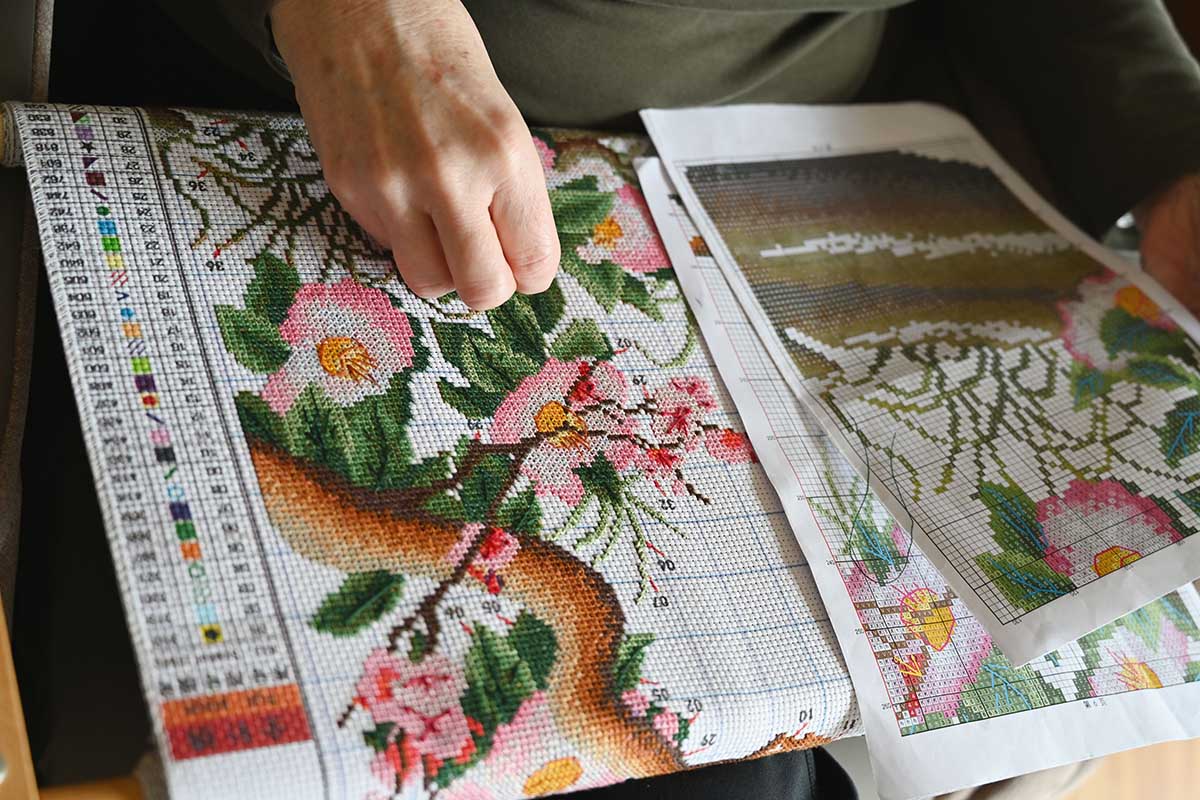
A cross stitch chart takes all of that away. It’s a grid.
Every square holds a symbol, every symbol means one specific thread, and nothing is left to interpretation. Find the square, make the stitch, move on.
You’d think that would be dull. It’s the opposite, and it’s why people describe stitching as the thing that finally shuts their brain up.
Your hands are busy and the part of you that makes decisions gets the night off. It’s closer to a jigsaw than to painting, and jigsaws get finished too.
Progress Is Visible from the First Evening
Motivation is mostly a feedback problem. The hobbies that lose people are the ones where nothing looks like anything for three weeks, because the reward turns up long after the work does.
Cross stitch pays out straight away. A row of stitches shows. Fifty stitches make a shape you can recognize.
On 14-count fabric, which has fourteen stitches to the inch and is where nearly everyone starts, an hour gets you something you can point at.
That matters more than it sounds. Think about any project you’ve actually finished.
There was an early moment where you thought, right, this is going to work. Cross stitch hands you that moment on the first evening instead of in week three.
It Costs Very Little to Find Out If You Like It
Most crafts want a real commitment before they’ll tell you whether you enjoy them.
Pottery needs a wheel or a class. Sewing needs a machine. Woodworking needs tools, space, and somewhere you’re allowed to make noise.
A full cross stitch kit is a hoop, a piece of Aida fabric, a blunt tapestry needle, small scissors, and some floss. In the US that’s under twenty dollars, and the fabric is the expensive part.
Thread is what surprises people. One skein of DMC cotton holds 8.7 yards, about eight meters, of six-stranded floss.
Most stitching uses two of those six strands, so a single skein covers roughly 1,800 stitches on 14-count.
A small design often needs one skein per color, at well under a dollar each.
Low stakes change everything. Nobody feels obliged to finish a project to justify fifteen dollars, which is exactly why they’re more likely to.
It Fits Into the Gaps in a Normal Day
Here’s the advantage nobody mentions: cross stitch has no setup and no cleanup.
Painting means getting things out and putting them away. Sewing means clearing a table. Both rituals are small.
Both are enough to stop you bothering on a tired Tuesday, because twenty spare minutes stop being worth it once eight of them go on admin.
A hoop lives in a bag. Pick it up, stitch four rows while something plays in the background, put it down mid-row. Nothing dries out.
Nothing needs rinsing. Nothing has to be finished before bed.
A craft that survives being interrupted is a craft that gets finished, because real life is mostly interruptions.
The Math Tells You What You’re Signing Up For
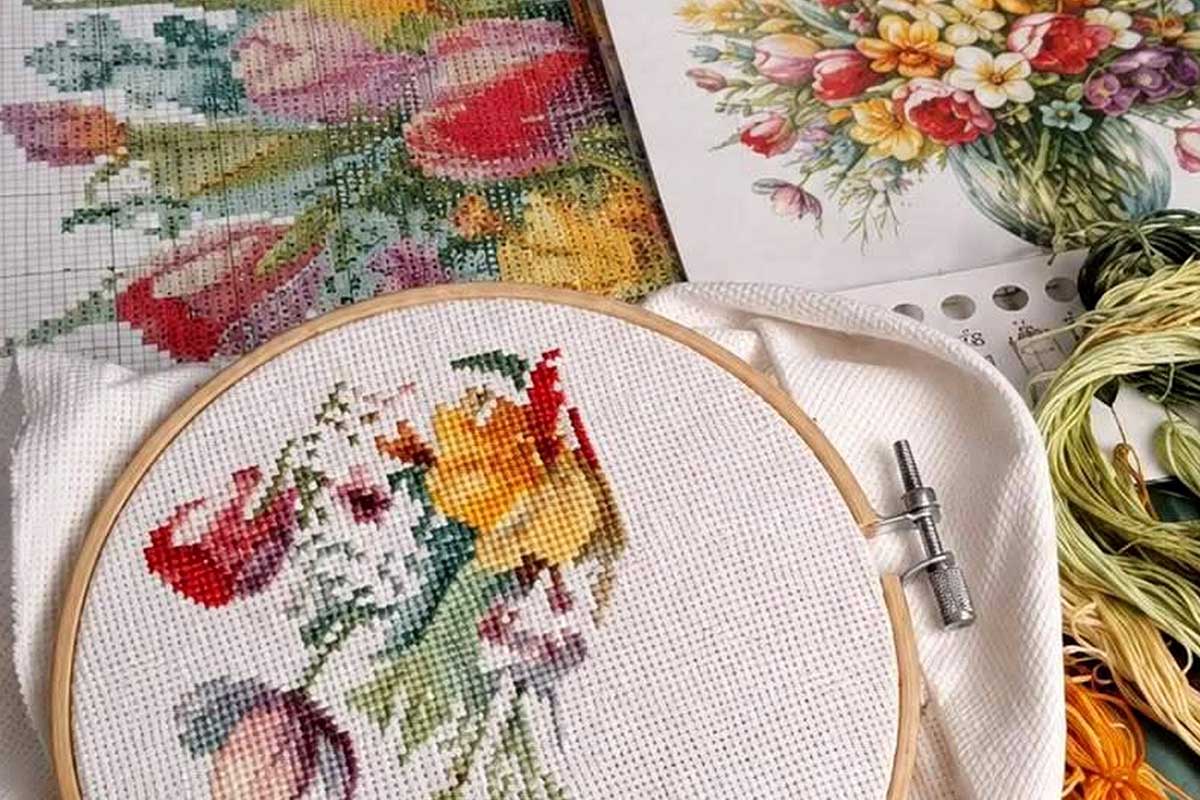
Cross stitch is unusual in being predictable. Two numbers, both printed on any pattern worth buying, tell you nearly everything.
- Finished size: divide the stitch count by the fabric count. A design 140 stitches wide on 14-count comes out at exactly ten inches. Switch to 18-count and the same design shrinks to under eight, without changing a single stitch.
- Effort: the total stitch count is the honest measure. Twelve thousand stitches is a real commitment. Three thousand is a couple of weekends. Two designs can look equally complicated in a photo and differ by a factor of four.
No other craft tells you the size of the job before you commit.
Do that arithmetic before you buy, especially on a first project, and especially when the picture is prettier than your free time.
The One Thing That Really Kills Projects
When beginners give up on cross stitch, there’s almost always one culprit, and it isn’t difficulty. It’s confetti.
Confetti is what stitchers call single stitches of a color scattered across a design, never touching another stitch of the same shade.
Each one costs you what a solid block of forty costs: find the spot, thread the needle, secure the tail, make the stitch, secure it again. Then you look at the fabric and can’t see that anything happened.
It comes from photographs converted into charts by software, where nobody edited the palette afterwards.
A machine matching a photo will cheerfully use sixty colors where a person would use fifteen, and the preview image won’t show you the difference. Your third evening will.
You can catch it before paying. Take the grid, width in stitches times height, and divide by the number of colors.
That’s roughly how many squares each color has to work with.
A big number means colors form real shapes you can stitch in runs. A small one means scatter.
Any listing that hides the color count is worth walking away from, and shops that publish it, like Clover Stitchery, are usually the ones that edited the palette by hand.
What to Buy for a First Project
Keep the first one small enough to finish inside two weeks. Momentum beats ambition at this stage.
- Fabric: 14-count Aida in white or cream. The holes are easy to see and it’s what most beginner patterns assume.
- Hoop: five or six inches, wood or plastic. It keeps the fabric tight, which keeps your stitches even.
- Needle: size 24 tapestry needle. Blunt on purpose, so it slides between the fabric threads instead of splitting them.
- Thread: whatever the pattern lists, bought by number rather than by eye. Beige, tan, gray and pale blue are nearly impossible to tell apart under a warm bulb, which is what a guide to choosing DMC floss colors goes into.
- Scissors: small, sharp, and kept for thread only.
Pick something with a stated stitch count under about 6,000 and fewer than fifteen colors.
That’s an evening or two a week for two weeks, and it ends with something framed instead of something in a drawer.
Conclusion: Start Smaller Than You Think
Cross stitch projects get finished not because the craft is effortless, but because it gives beginners what they need at the right time:
- Clear instructions from the beginning;
- Visible progress during each session;
- Affordable, compact supplies;
- A repeatable technique that becomes relaxing;
- More difficult decisions only after confidence develops;
The main mistake is choosing a first pattern because the finished photograph looks beautiful without checking the work required.
Before buying, review the stitch count, finished dimensions, number of colors, and amount of detailed stitching.
If you are deciding between two designs, choose the smaller one.
Completing it will give you more than a finished piece, it will provide the satisfaction of keeping a promise to yourself.
That small success builds confidence, creates momentum, and makes the ambitious pattern feel exciting rather than overwhelming.
You can always choose the larger project next.
Very few abandoned hobbies give you such a convincing reason to believe that you actually will.