5 Famous Dragon Paintings and the Stories Behind Them
Long before dragons became fixtures of fantasy movies, television series, video games, and bestselling novels, artists were putting them on walls, manuscripts, scrolls, and canvases.
The fascination is remarkably persistent.
Across different cultures and historical periods, dragon-like creatures have represented dramatically different ideas, from chaos, danger, and destruction to strength, wisdom, protection, and good fortune.
That changing symbolism is part of what makes dragons such an interesting subject in art.
For anyone interested in dragon paintings and the history of dragons in art, these works offer more than spectacular mythical creatures.
They provide a glimpse into what different societies feared, admired, and imagined.
✨ Key Points About Dragons in Art
- Dragons appear in art across cultures and centuries: European and Asian artistic traditions both developed rich dragon imagery, although their meanings and visual characteristics can be very different.
- Dragon symbolism changes depending on the culture: In European traditions, dragons have frequently been depicted as dangerous creatures to defeat, while Chinese dragons have often been associated with power, prosperity, water, and good fortune.
- Historic dragon paintings reveal more than mythology: Looking at how artists portrayed dragons can tell us about the religious beliefs, folklore, values, and artistic traditions of their time.
The following five dragon artworks show just how varied these mythical creatures can be.
From fearsome adversaries to powerful symbolic figures, each offers a different interpretation of one of humanity’s most enduring imaginary creatures.
Saint George and the Dragon by Gustave Moreau
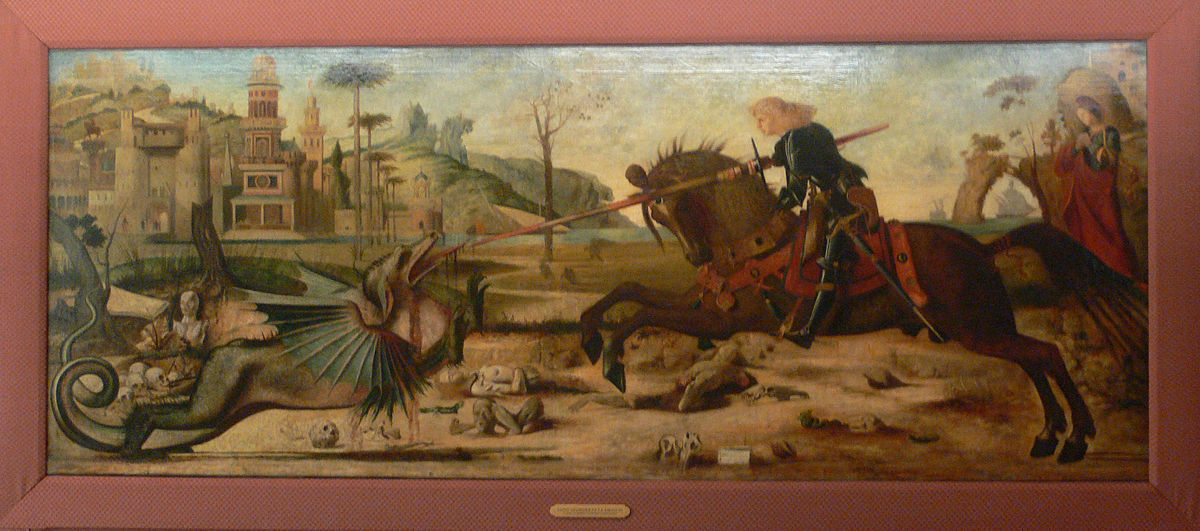
Few images capture the Western tradition of the heroic dragon-slayer as clearly as Saint George confronting a dragon.
French Symbolist painter Gustave Moreau returned to this centuries-old Christian legend in his Saint George and the Dragon, transforming the familiar battle into an elaborate vision of courage, faith, and conflict.
According to the traditional legend, a dragon terrorized a community and demanded sacrifices until Saint George confronted and defeated it.
The story became an enduring subject in European religious art, with the dragon commonly representing evil or a threatening force that must be overcome.
Moreau’s interpretation is particularly interesting because of its symbolism:
- Saint George represents courage and spiritual conviction, remaining composed while confronting a terrifying opponent.
- The dragon embodies danger, evil, and destructive forces, continuing a long tradition of dragon imagery in Christian European art.
- The battle can also be read psychologically, as an image of overcoming fear, temptation, or internal conflict rather than simply defeating a physical monster.
- The rescued princess reinforces the traditional narrative, although Moreau’s richly detailed treatment turns the scene into something more dreamlike and symbolic than a straightforward heroic adventure.
Rather than presenting the dragon as a universal symbol with one fixed meaning, Moreau leaves room for interpretation.
The creature can be understood as an external enemy, a spiritual threat, or even the darker forces within ourselves that must be confronted.
That ambiguity is precisely what gives Saint George and the Dragon its lasting power: the painting depicts an ancient legend while allowing each generation to recognize its own version of the dragon that needs to be defeated.
Japanese Sea Dragon by Utagawa Kuniyoshi
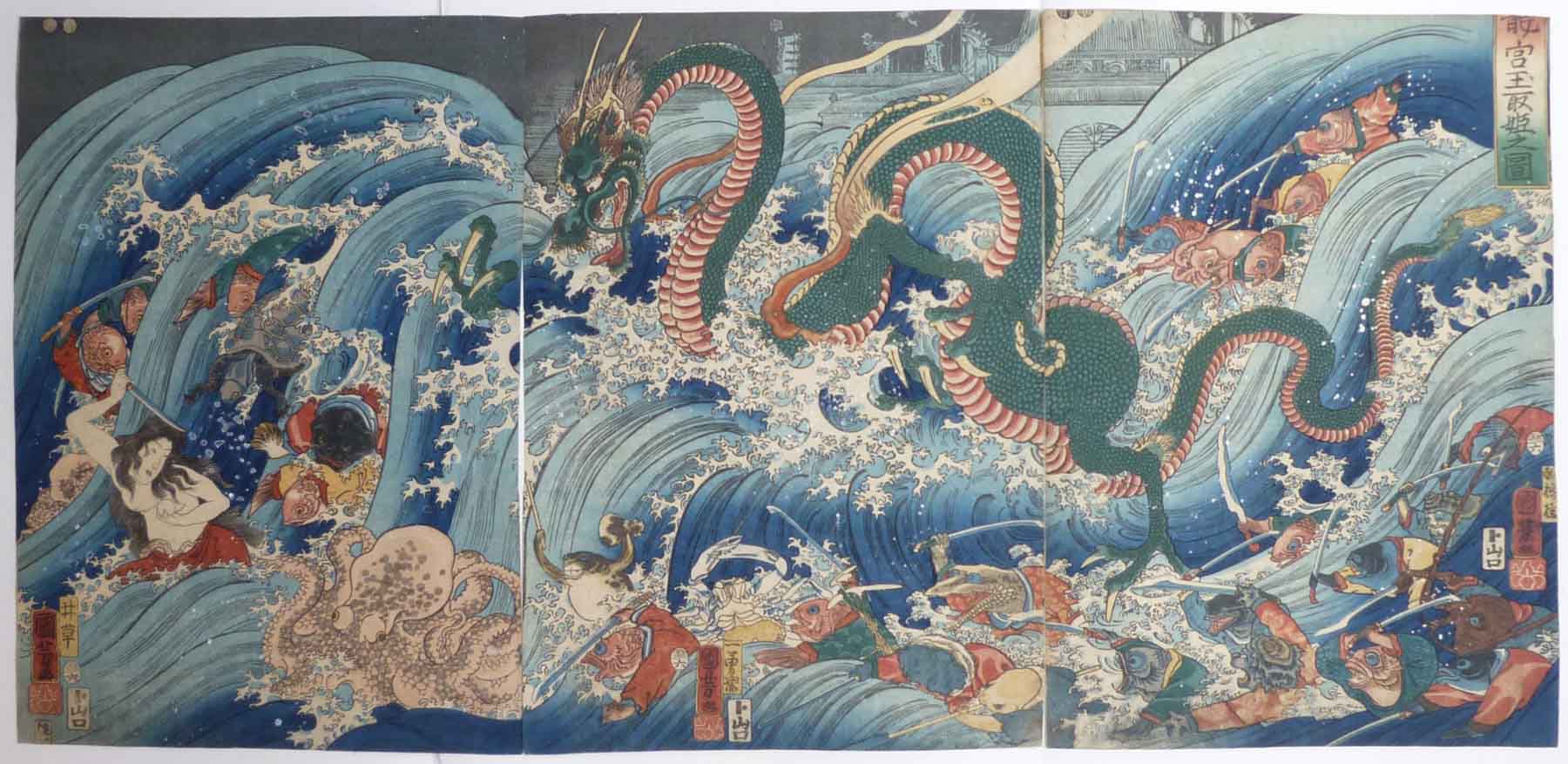
A very different image of the dragon emerges in the work of Japanese ukiyo-e artist Utagawa Kuniyoshi.
Rather than presenting the creature simply as a monster that must be defeated, Japanese dragon imagery draws on a long tradition in which dragons are closely connected with water, rainfall, natural forces, and supernatural power.
Dragon traditions developed differently across East Asia, so there is no single “Eastern” interpretation. Japanese dragons were strongly influenced by Chinese mythology and Buddhist traditions while developing distinctive characteristics of their own.
In Japanese art and mythology, dragons have been associated with:
- Water and rainfall, including seas, rivers, storms, and other powerful natural forces.
- Strength and supernatural power, making the dragon an imposing rather than merely frightening presence.
- Protection and authority, particularly in religious, legendary, and symbolic contexts.
- The forces of nature, which humans may respect and coexist with rather than simply conquer.
These associations help explain why the combination of a dragon and turbulent water is such a powerful recurring image in Japanese art.
In Kuniyoshi’s dramatic imagery, the dragon appears above surging waves and darkened skies, visually connecting the mythical creature with the immense power of the natural world.
The movement of the water makes the scene feel almost alive, while the dragon commands attention above the chaos below.
Unlike the European tradition of Saint George slaying a threatening dragon, this type of Japanese dragon painting invites a different relationship with the creature.
The dragon is not necessarily an enemy waiting to be defeated. Instead, it can embody the mysterious, unpredictable, and sometimes overwhelming power of nature itself.
The Dragon Ascending the Heavens by Ogata Gekkō
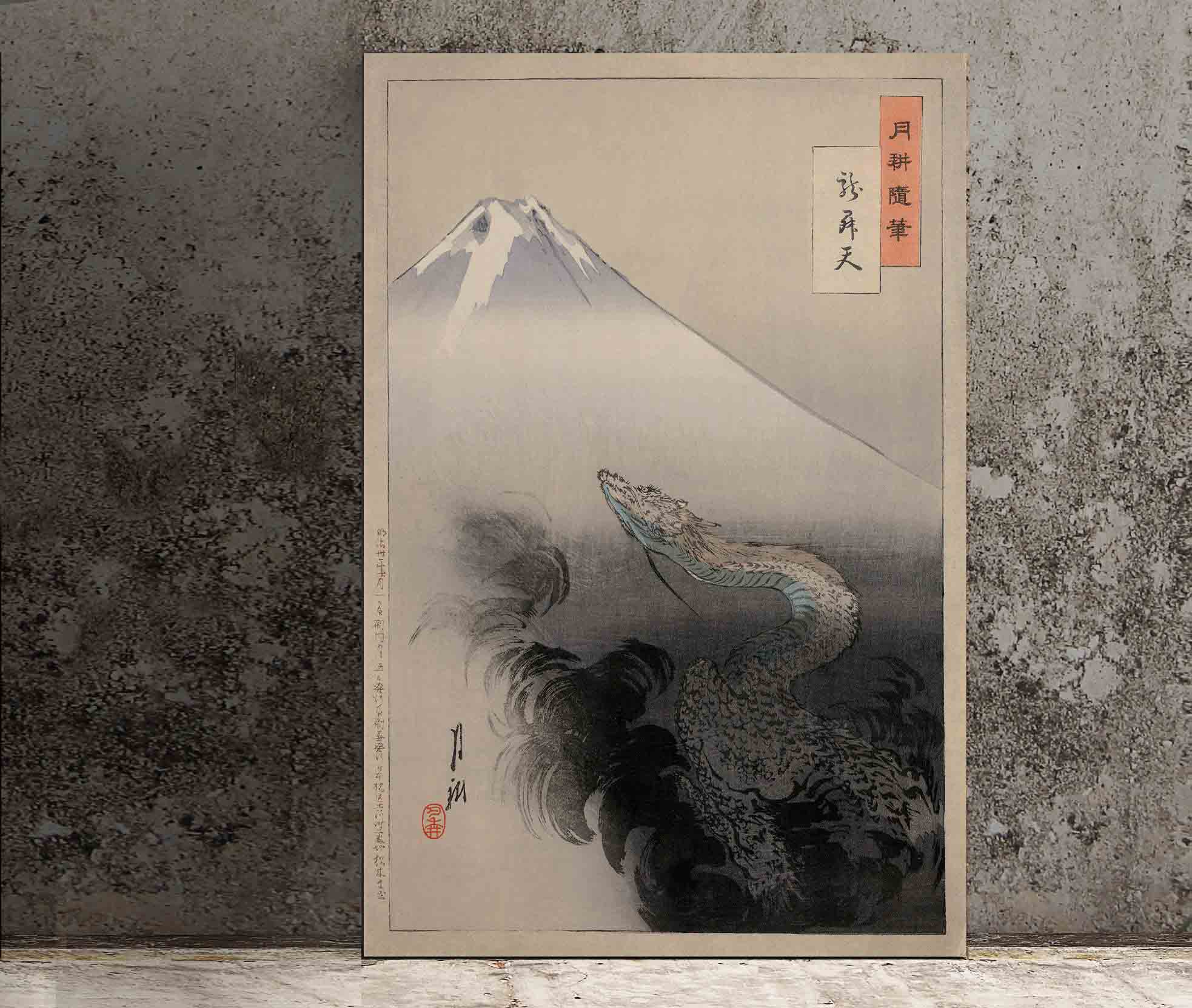
Japanese artist Ogata Gekkō offers another striking interpretation of the dragon, this time emphasizing movement, ascent, and supernatural power.
Gekkō worked during Japan’s Meiji period, when artists were navigating a rapidly changing visual culture while continuing to draw inspiration from traditional Japanese subjects and techniques.
In The Dragon Ascending the Heavens, the upward-moving dragon immediately becomes the focus of the composition.
Rather than depicting a conventional battle between hero and monster, the image connects the creature with the sky, clouds, and forces beyond the human world.
Several elements make the painting particularly compelling:
- The ascending dragon suggests movement and power, drawing the viewer’s attention upward through the composition.
- The limited palette creates dramatic contrast, allowing the dragon’s form and surrounding atmosphere to dominate without unnecessary visual distraction.
- Dragons traditionally have strong connections with natural forces in East Asian mythology, particularly clouds, rain, storms, and water.
- The ascent can invite symbolic interpretations, including transformation, spiritual elevation, ambition, or the movement between earthly and celestial realms.
The painting’s restraint is part of its impact.
Instead of filling the scene with elaborate narrative details, Gekkō allows the dragon, landscape, and surrounding space to carry much of the visual meaning.
It is tempting to interpret the contrast between dark and light as a direct representation of good versus evil or yin and yang, but that reading should not be treated as the painting’s definitive meaning without historical evidence.
The work is perhaps more interesting when viewed as an exploration of power, transformation, nature, and ascent, ideas that have surrounded dragon imagery in East Asian art for centuries.
Nuada the High King by Jim Fitzpatrick
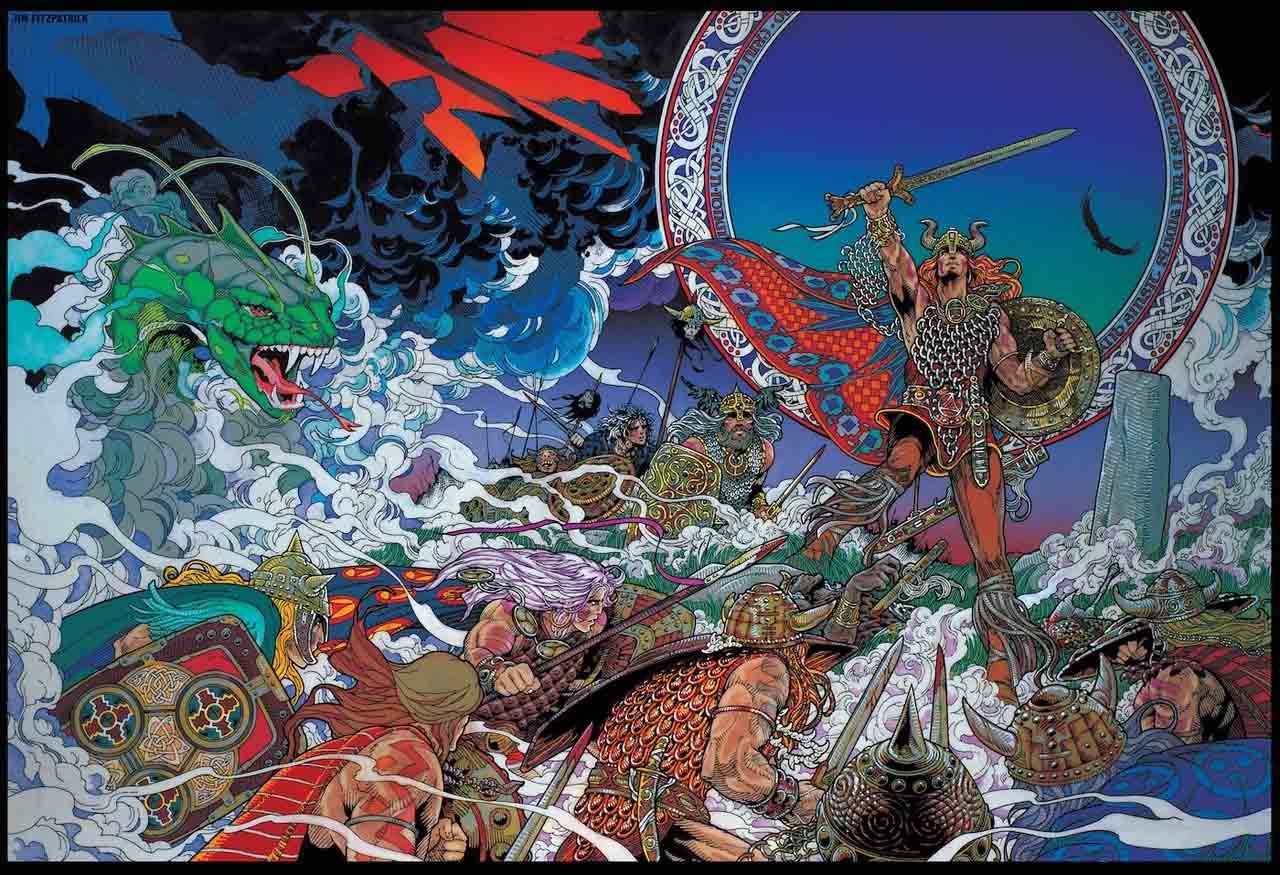
Dragons are not confined to medieval Christian legends or East Asian mythology.
In modern fantasy and mythological art, they continue to appear alongside ancient heroes, warriors, and supernatural figures, and Irish artist Jim Fitzpatrick has built some of his best-known work around precisely this kind of imagery.
Fitzpatrick is internationally recognized for his famous graphic portrait of revolutionary Che Guevara, but his artistic career extends far beyond that single image.
His richly detailed illustrations inspired by Irish and Celtic mythology have introduced generations of viewers to legendary figures and stories through a distinctive modern visual style.
Nuada the High King is associated with Fitzpatrick’s The Book of Conquests, his illustrated interpretation of stories drawn from Ireland’s mythological tradition.
The image presents Nuada as a commanding warrior surrounded by an elaborate world of mythological imagery.
Several details give the artwork its sense of power:
- Nuada dominates the composition, immediately establishing him as the central figure and authority within the scene.
- The figures beneath him emphasize conflict and conquest, reinforcing the image of a warrior king who has survived or overcome formidable opposition.
- The dragon adds another layer of supernatural danger, expanding the scene beyond an ordinary human battle.
- Intricate Celtic-inspired details connect the fantasy imagery with Irish mythology, an important influence throughout Fitzpatrick’s work.
- The combination of hero, enemies, and mythical creature creates a modern interpretation of ancient legend, rather than attempting to reproduce historical Celtic art literally.
The dragon is particularly interesting because its meaning does not need to be reduced to a simple battle between good and evil.
Within the composition, it contributes to a larger atmosphere of danger, supernatural power, heroism, and conquest.
That makes Nuada the High King a useful example of how dragon imagery continues to evolve.
Fitzpatrick takes inspiration from ancient mythology but presents it through the visual language of modern fantasy art, demonstrating that dragons remain powerful artistic symbols even when they move far beyond their original mythological traditions.
Smaug in The Hobbit: A Modern Vision of the Dragon
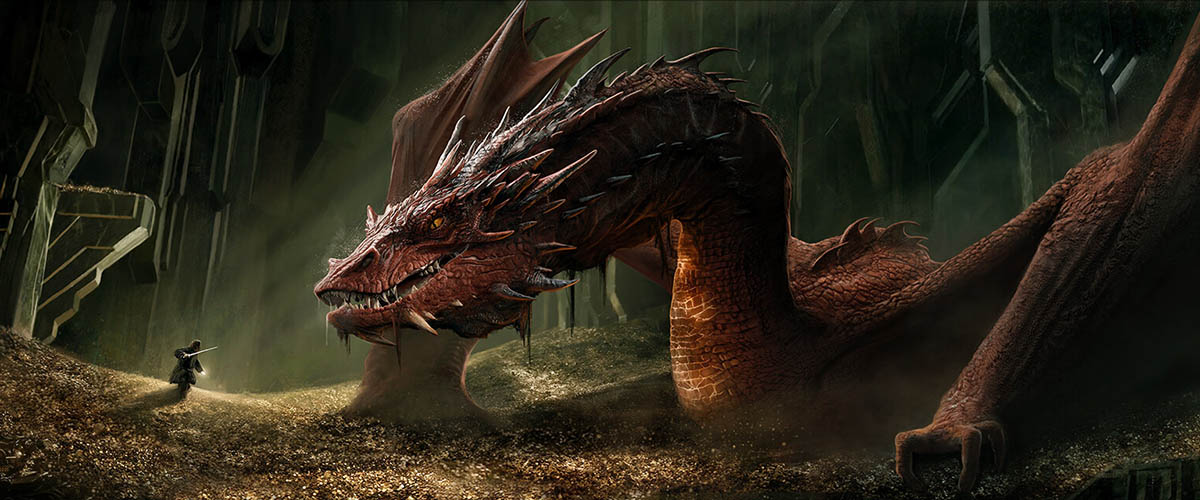
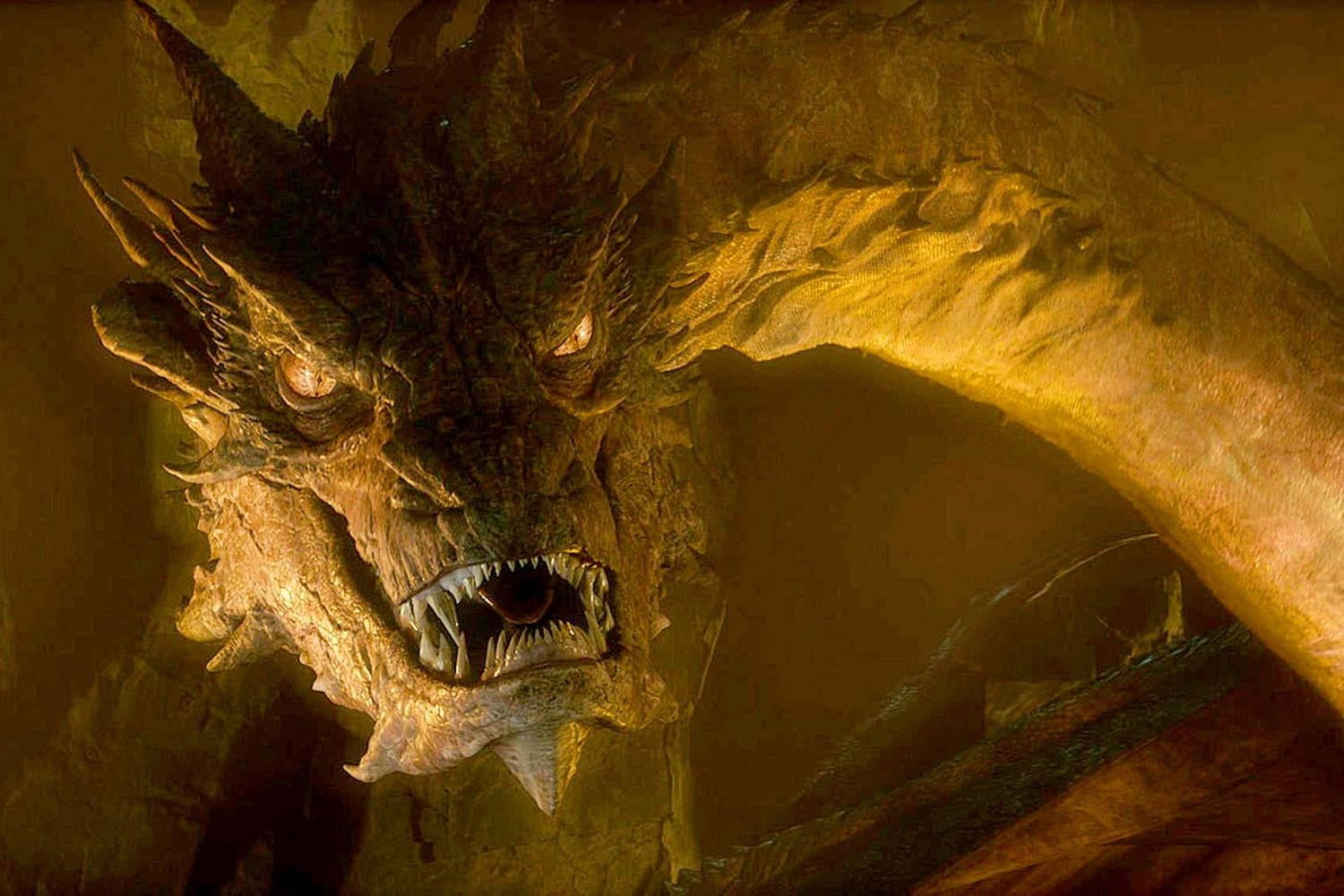
To understand how ancient dragon symbolism survives in modern culture, few examples are more recognizable than Smaug, the formidable dragon at the center of J.R.R. Tolkien’s The Hobbit.
Smaug draws on characteristics that have long appeared in European dragon traditions: enormous physical power, fire, danger, and the guarding of treasure.
But Tolkien gives those familiar characteristics a memorable personality.
Smaug is intelligent, calculating, proud, and consumed by his attachment to the vast treasure he has claimed.
Several elements make Smaug particularly significant as a modern interpretation of the dragon:
- Greed is central to his character. Smaug possesses an enormous treasure but has little practical use for it, making his hoard a powerful image of wealth accumulated simply for the sake of possession.
- His treasure represents both wealth and danger. The gold attracts those who want to reclaim it while also becoming a source of conflict.
- Smaug combines physical and psychological power. He does not rely solely on fire and size; he also attempts to manipulate and intimidate through conversation.
- His defeat follows the traditional dragon-slayer narrative, in which an apparently overwhelming creature ultimately proves vulnerable.
- The story gives an ancient mythological figure a modern personality, helping explain why Smaug has become one of fantasy literature’s most recognizable dragons.
It is tempting to reduce Smaug to the idea of “defeating your inner demons to claim your gold,” but Tolkien’s story is more complicated than that.
The treasure itself creates new problems even after the dragon is gone.
In that sense, Smaug does not simply symbolize an obstacle standing between people and wealth—he also draws attention to what the desire for wealth can do to those pursuing it.
What Dragon Paintings Reveal About Art, Mythology, and Culture
From religious battles and supernatural forces to powerful kings and treasure-hoarding monsters, dragons have never carried just one meaning.
Their extraordinary longevity in art comes partly from their ability to represent whatever a particular culture, or artist, finds powerful, dangerous, mysterious, or desirable.
Across the artworks and traditions explored here, dragons have represented:
- Danger and evil, particularly in European Christian imagery such as Saint George and the Dragon.
- Nature and supernatural power, prominent themes in Japanese and other East Asian dragon traditions.
- Strength, authority, and transformation, depending on the historical and cultural context.
- Heroism and mythological conflict, especially when dragons appear alongside warriors and legendary figures.
- Greed and the dangerous attraction of wealth, memorably embodied by Tolkien’s Smaug.
That variety is what makes dragon art and mythology so enduring.
The creature may change its appearance and meaning from one culture to another, but it repeatedly gives artists a way to visualize forces that are otherwise difficult to represent: fear, ambition, chaos, nature, power, and desire.
These five examples are only a starting point.
Exploring mythical paintings more broadly reveals how artists have continually reinvented legendary creatures and ancient stories to reflect the beliefs and concerns of their own time.