What Painting Made Henri Rousseau Famous?
✨Key Points
- The Dream is Rousseau’s most famous painting today.
- His jungle paintings, not one sudden success, built his reputation.
- Picasso and the Paris avant-garde helped secure his recognition before his death.
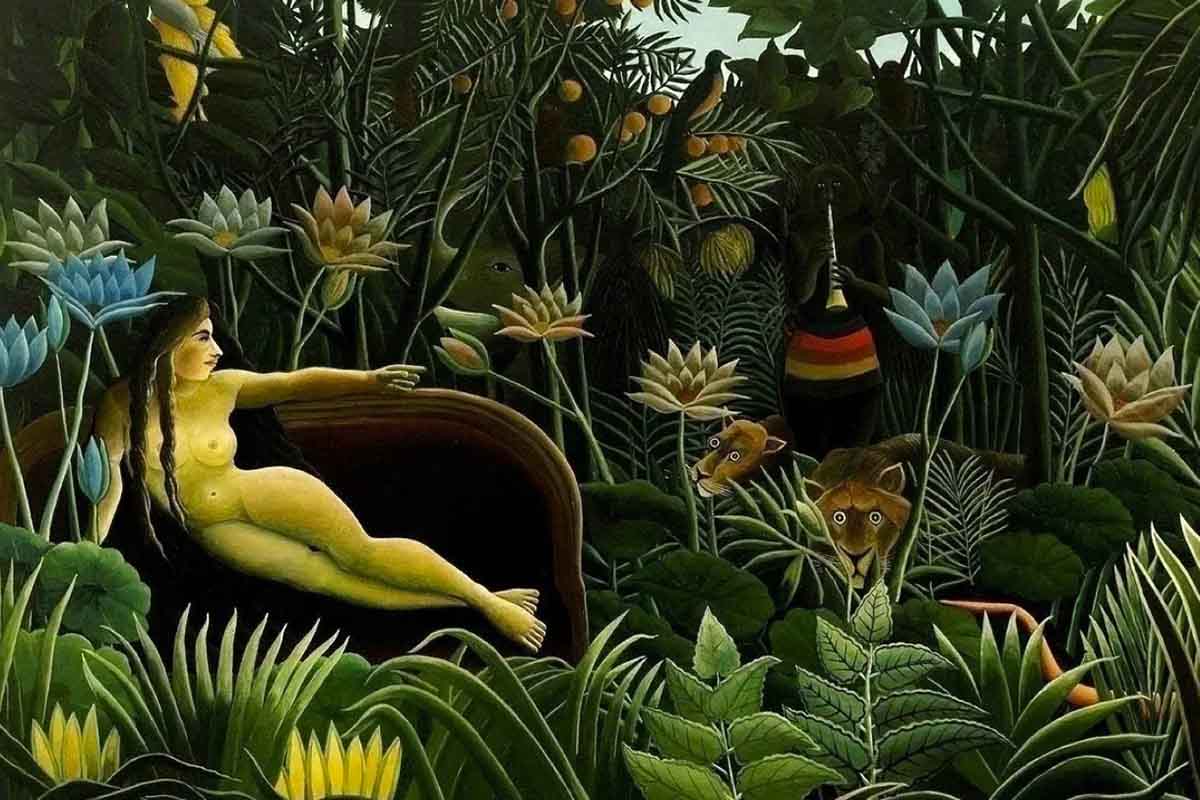
If one work must be named, The Dream (1910) is generally considered Henri Rousseau’s most famous painting today.
However, no single canvas suddenly transformed his career.
His reputation developed gradually through a sequence of strange, dreamlike jungle scenes that fascinated younger avant-garde artists even while many critics mocked his self-taught technique.
Three works help explain his rise:
- Tiger in a Tropical Storm (Surprised!) (1891): Rousseau’s first jungle painting established the imaginative subject for which he became known.
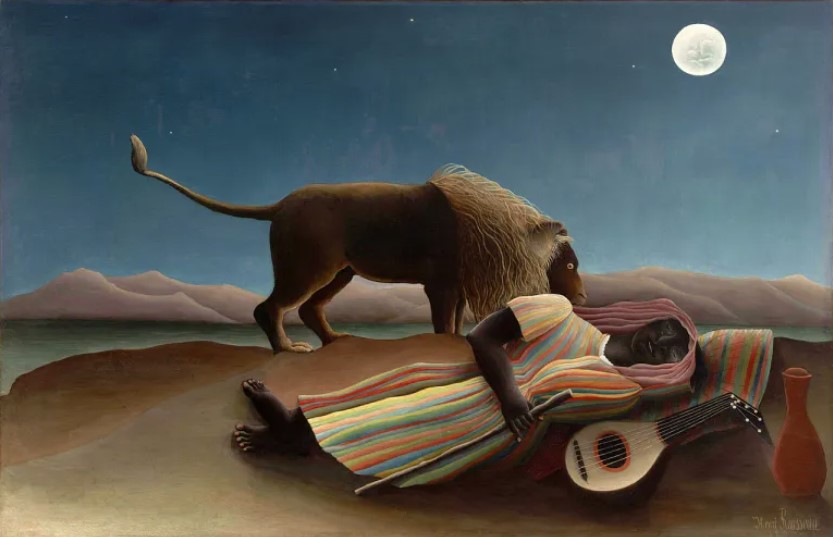
- The Sleeping Gypsy (1897): Its mysterious desert scene demonstrated his ability to make an invented world feel psychologically powerful.
- The Dream (1910): Completed during the final year of his life, this monumental jungle fantasy became the defining image of his artistic legacy.
Born in France in 1844, Rousseau worked as a municipal customs employee and pursued painting seriously later in life without formal academic training.
He is now associated with Naïve art, although the apparent simplicity of his style conceals carefully organized compositions, flattened color, and an extraordinary visual imagination.
Recognition did not arrive through one conventional breakthrough.
By 1908, Rousseau had captured the attention of Pablo Picasso and his circle, who celebrated him at the famous banquet held in his honor.
His story is therefore larger than the question of which painting made him famous: it shows how an artist dismissed for looking unsophisticated eventually influenced the very people redefining modern art.
Tiger in a Tropical Storm (Surprised!), 1891
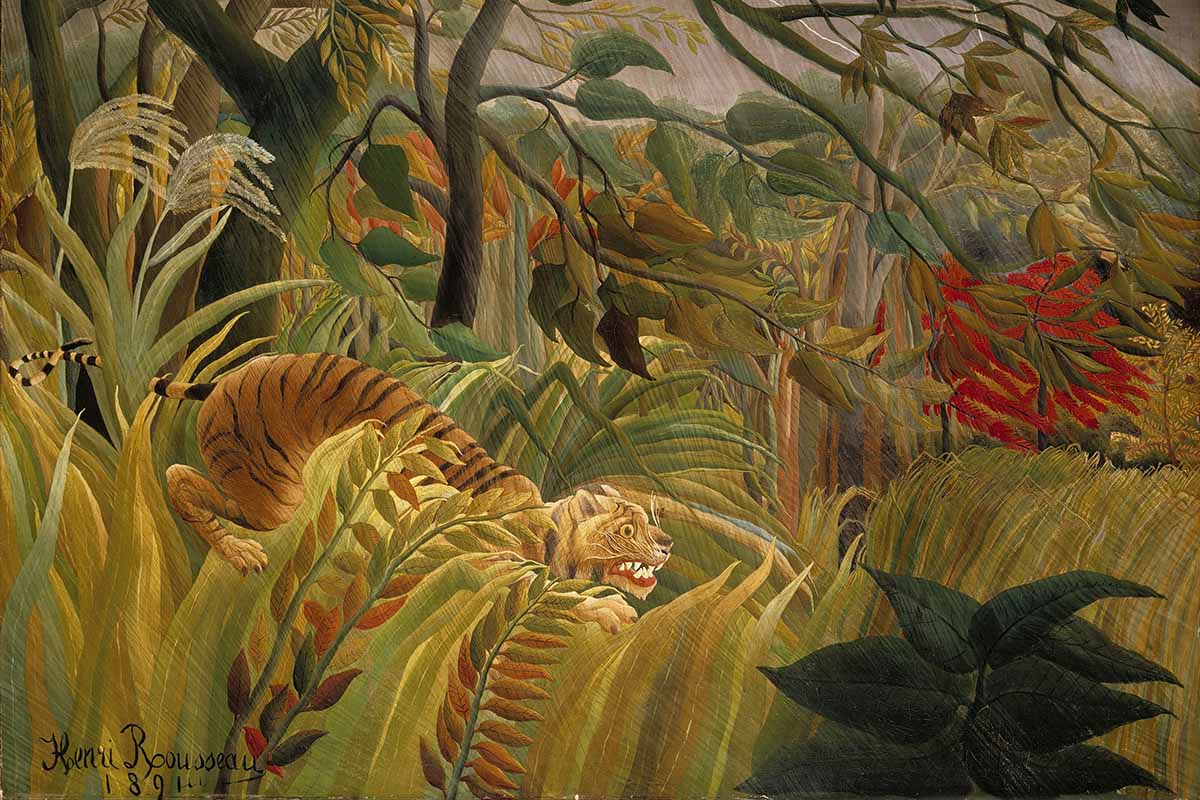
Henri Rousseau first attracted serious critical attention with Tiger in a Tropical Storm (Surprised!), exhibited at the Salon des Indépendants in 1891.
The dramatic scene leaves us with an intriguing question: is the crouching tiger preparing to attack unseen prey, or has the lightning startled the animal itself?
The painting became the first of approximately 20 Henri Rousseau jungle paintings.
Although many critics mocked his unconventional style, Swiss artist and writer Félix Vallotton recognized its power, describing the tiger as “the alpha and omega of painting.”
Rousseau did not return to jungle scenes until 1904, yet this early experiment established the imaginary wilderness that would define his legacy.
It paved the way for celebrated works such as The Hungry Lion Throws Itself on the Antelope and The Dream.
Today, Surprised! remains one of the clearest examples of how the qualities once criticized in Rousseau’s art ultimately made it unforgettable.
La Bohémienne endormie (The Sleeping Gypsy), 1897
Exhibited at the Salon des Indépendants in 1897, The Sleeping Gypsy is now one of Henri Rousseau’s most famous paintings, although it received little recognition during his lifetime.
The dreamlike scene depicts a sleeping traveler dressed in richly colored clothing, with a mandolin and water vessel beside her.
A lion quietly approaches and studies her beneath a luminous full moon.
The encounter feels dangerous, yet strangely peaceful, the lion appears curious rather than ready to attack.
That unresolved tension between vulnerability and safety gives the painting its enduring mystery.
Rousseau unsuccessfully offered the work to the mayor of Laval, his hometown in western France.
It subsequently belonged to a Parisian charcoal merchant before art critic Louis Vauxcelles discovered it in 1924.
After passing through several collections, it entered New York’s Museum of Modern Art in 1939 as a gift funded by Mrs. Simon Guggenheim.
Its flat perspective, precise outlines, unexpected scale, and poetic atmosphere once seemed unsophisticated to critics.
Today, those same qualities make The Sleeping Gypsy a landmark of Naïve art and a powerful reminder that an artwork can find its audience long after its creator is gone.
The Hungry Lion Throws Itself on the Antelope, 1905
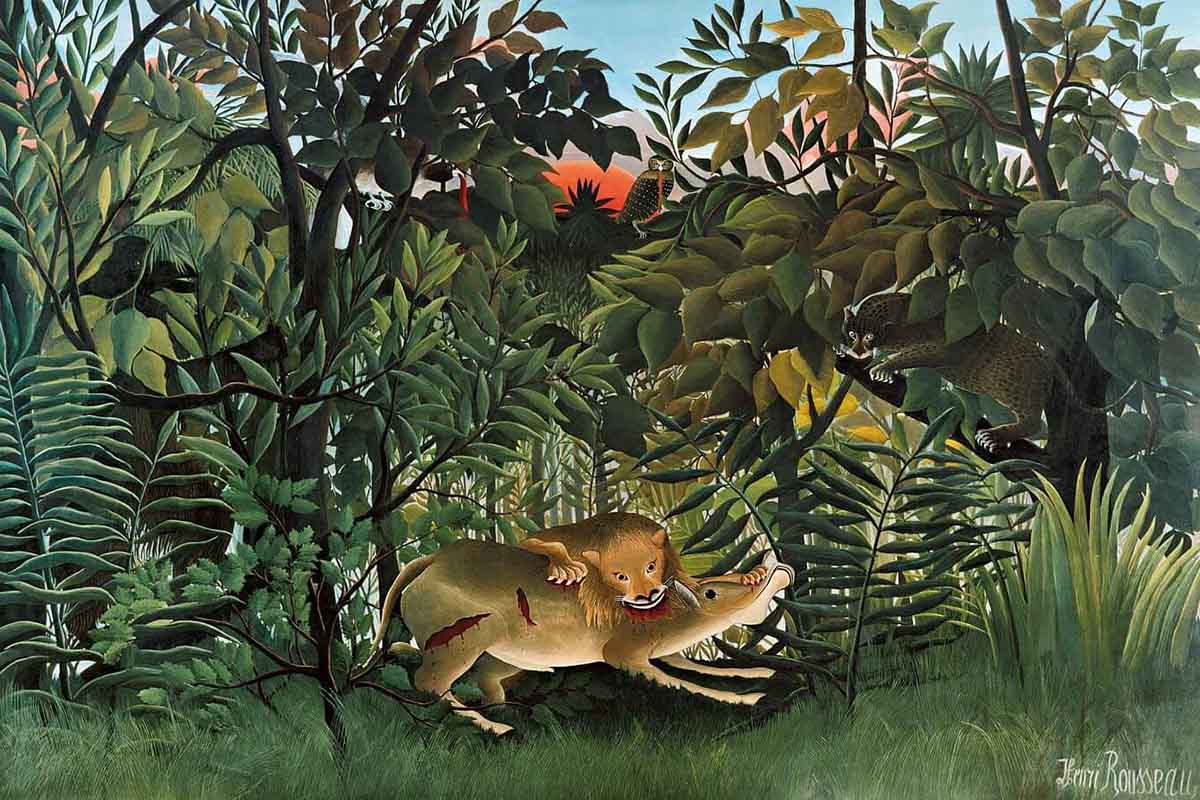
Known in French as “Le lion ayant faim se jette sur l’antilope,” this Henri Rousseau’s art marked his return to his Primitive jungle painting style.
It is a painting of a lion catching its prey, with other wild jungle animals like a panther and owl waiting atop trees to have their piece of the downed animal later.
The Henri Rousseau painting is one of the artworks that served as inspiration for naming the Fauvism art style, even though he didn’t apply it to his works.
As it was displayed in the same room at the Salon d’Automne alongside Donatello’s sculptures and works from other avant-garde artists like Henri Matisse and Cezanne, Louis Vauxcelles made a mention of “Donatello chez les Fauves – Donatello among the wild beasts.”
The term then became popular for artworks applying strong colors with impressionism.
Today, The Hungry Lion Throws Itself on the Antelope is displayed at the Fondation Beyeler in Basel, Switzerland.
The Snake Charmer
Commissioned by Berthe, the mother of Robert Delaunay, who co-founded the Orphism Art Movement with his wife, The Snake Charmer is another intriguing and famous Henri Rousseau piece.
The Musée d’Orsay calls the charmer “a black Eve in a disquieting Garden of Eden.” It depicts a woman with glowing eyes playing the flute to call out snakes from the thick jungle vegetation, with all significant subjects darkened against the moonlight.
Exhibited in the Salon d’Automne in 1907, the piece was held for over a decade by Jacques Doucet, a popularly known fashion designer and enthusiast. It was eventually displayed at the Louvre in 1937 and currently sits at the Musée d’Orsay.
The Flamingoes – Henri Julien Rousseau
The Significance of the Portrait of Clemence to Picasso and Le Banquet Rousseau
The 1903 Portrait of Clemence is not one of the best Henri Rousseau paintings but is one that ultimately led to, perhaps, the most popular event defining 20th-century art. How?
Well, Picasso bought it from the street-side as a canvas piece for the paint to be applied and thought he was the first to discover Henri Rousseau.
A young Picasso became a fan of Henri Rousseau and, in 1908, held Le Banquet Rousseau in respect to him.
The banquet was in Picasso’s studio and attended by a barrage of famous French avant-garde artists, including Guillaume Apollinaire.
The avant-garde was a less popular art style during this time, and the banquet represented the beginning of its revolutionary but short-lived takeover.
After this, The Dreams, another one of Henri Rousseau’s jungle paintings, was displayed in the Salons des Independants in 1910, just five months before his death.
Guillaume Apollinaire, a close friend of his, wrote the epitaph on his tombstone.
What Painting Made Henri Rousseau Famous? Final Thoughts
Henri Rousseau was not simply an unlucky member of the avant-garde. He was an outsider whose art challenged the qualities that critics believed a serious painter should possess.
His unusual proportions, flattened perspective, and imagined jungles were treated as evidence of incompetence before later generations recognized them as the source of his originality.
His legacy rests on three important truths:
- The Dream became his defining masterpiece, but several earlier works gradually established his reputation.
- Rejection did not prevent recognition: Picasso and other young artists valued the imagination critics had dismissed.
- A late beginning did not limit his influence: Rousseau developed his artistic career in adulthood and ultimately changed how self-taught art was perceived.
Rousseau never received all the recognition he wanted during his lifetime, but his story is not only tragic.
It is a reminder that originality can look like failure when judged by established rules.
The qualities that once made his paintings easy to ridicule are precisely what make them impossible to confuse with anyone else’s today.