How to Improve Venue Security: Weapon Detection, Screening and Crowd Safety
✨ Key Points
- Venue security must balance threat detection with visitor flow. Stadiums, arenas, and entertainment venues need to identify potential weapons and security risks without creating long screening lines during peak arrival times.
- AI weapon detection and high-throughput screening can improve entrance security. Modern systems help security teams identify potential threats while reducing unnecessary manual checks and allowing legitimate guests to keep moving.
- Effective venue protection extends beyond the entrance. A strong security strategy combines weapon detection, access control, video surveillance, crowd management, trained staff, and clear emergency-response procedures.
For a stadium, arena, concert venue, convention center, or other high-traffic business, security becomes most difficult when safety and speed have to happen at the same time.
Consider a typical sold-out event.
Thousands of guests may arrive within the final 30 to 60 minutes before the event starts.
Entrances suddenly become crowded, security staff have limited time to assess potential threats, and even a small slowdown at screening checkpoints can create long lines outside.
Increasing security by simply checking everyone more thoroughly may sound sensible, but it can create another problem: congestion, frustrated guests, overwhelmed employees, and crowds gathering in areas that may themselves need to be protected.
For venue operators, the challenge is therefore bigger than stopping prohibited items at the door.
A modern venue security strategy needs to address several risks at once:
- Detect potential weapons and other serious threats before they enter crowded areas.
- Maintain screening throughput during peak arrival periods without sacrificing security standards.
- Reduce unnecessary secondary checks so security teams can focus their attention on meaningful alerts.
- Manage entrances, exits, queues, restricted areas, and crowd movement as parts of one security system rather than separate problems.
- Protect the guest experience, because visitors increasingly expect security to be effective without making entry unnecessarily slow or invasive.
This is why protecting a busy venue is no longer just about hiring more guards or installing cameras.
Technologies such as AI weapon detection systems, intelligent video surveillance, access control, high-throughput security screening, and real-time alerting can help security teams identify potential risks while keeping legitimate visitors moving.
The goal is not to make a venue feel like a security checkpoint.
It is to build security into everyday operations so that the people responsible for safety have better information, guests experience fewer unnecessary interruptions, and the venue is better prepared when something genuinely requires attention.
Here is how venue owners, security directors, and operations teams can build that kind of protection without turning safety measures into another operational bottleneck.
Physical Security Measures
Good security starts with physical measures.
This includes installing strong locks and maintaining clear sightlines throughout your venue.
Well-placed security cameras and well-lit entry and exit points can create a safer environment for staff and patrons.
Regular maintenance checks of your security installations can help prevent issues.
Training staff to recognize and report suspicious activities is also important.
Staff who know the venue well can spot anything unusual.
When employees feel confident in their training, they can act quickly, which helps keep the venue safe.
Building a relationship with local law enforcement can also be beneficial.
Officers can share information on crime trends, allowing you to implement tailored security measures.
Regular communication keeps your staff informed and ready for any situation.
Access Control Systems
A busy venue rarely has just two categories of people: those who are allowed inside and those who are not.
On an event day, employees, performers, contractors, vendors, media, VIPs, delivery teams, and thousands of guests may all need access to different parts of the property at different times.
This makes access control an important part of venue management, particularly when teams need to protect backstage areas, control rooms, offices, loading docks, equipment spaces, and other restricted zones without disrupting normal operations.
Modern access control can help venues:
- Assign access by role, location, and schedule, so a contractor entering a loading area does not automatically gain access to staff-only or backstage spaces.
- Change or revoke permissions quickly when staffing, vendors, credentials, or event requirements change.
- Create digital records of entry and exit activity, giving security teams useful information when investigating an incident or reviewing procedures afterward.
- Connect visitor management with employee and contractor access, providing a clearer picture of who is authorized to be in sensitive areas.
- Generate real-time alerts for unusual access attempts, allowing staff to investigate activity rather than discovering it later.
Key cards and badges remain common, but venues can also use mobile credentials, biometrics, and other identity-based access technologies depending on their operational and security requirements.
The real value is not simply replacing a physical key.
For large venues, access control creates different layers of authorization within the same property, helping venue management teams maintain an open, efficient environment for guests while keeping operational and sensitive spaces appropriately restricted.
Weapon Detection Systems
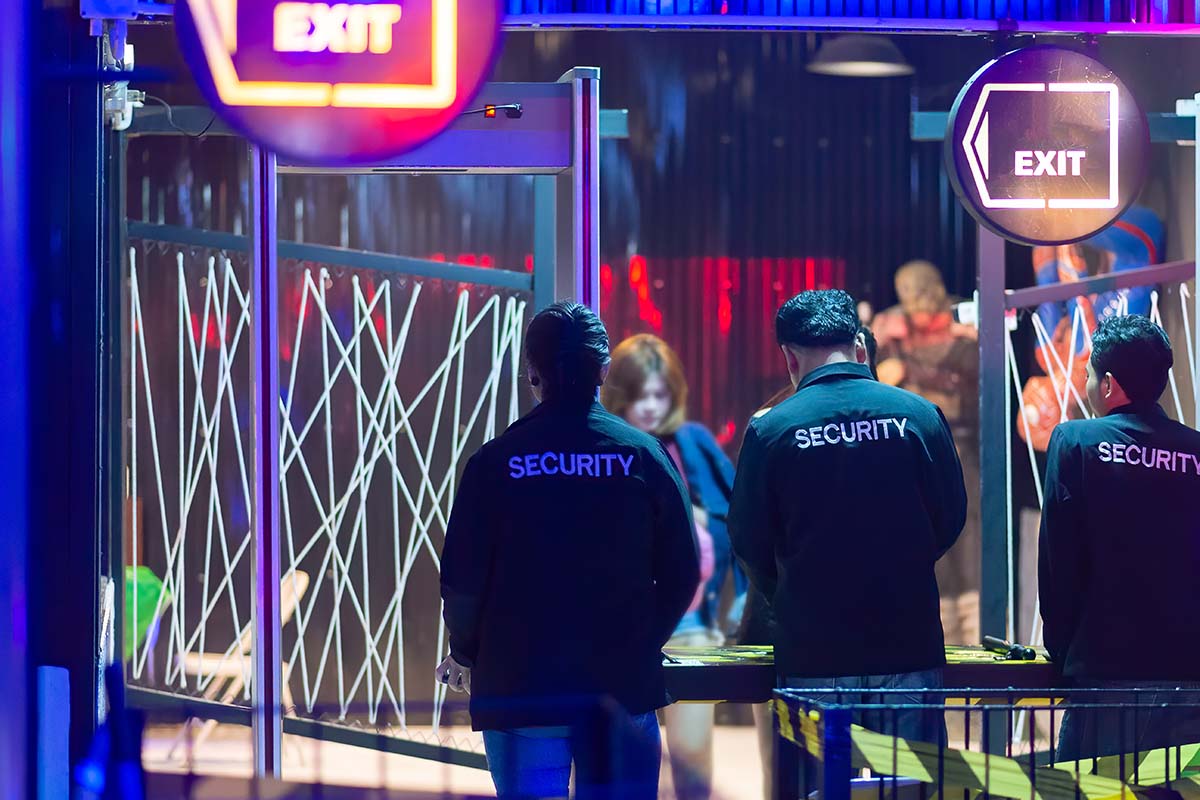
Adding a weapon detection system to your security plan can greatly improve safety at busy venues.
These systems help monitor for possible threats, making patrons and staff feel secure.
With the right technology, you can screen visitors for weapons efficiently without disruption, keeping operations running smoothly.
These systems work discreetly, using sensors to detect firearms and other prohibited items in real time.
You can place installations at entry points or integrate them into existing surveillance systems for easier management.
By focusing on security this way, you show your commitment to everyone’s safety.
Besides preventing incidents, weapon detection systems can also discourage potential troublemakers.
When people know these systems are in place, they are less likely to misbehave.
ID scanning is essential for age-restricted venues, helping staff verify guests before entry and reduce compliance risks.
This proactive measure helps create a safer, more welcoming environment where guests can enjoy their time without unnecessary safety concerns.
AI Weapon Detection
Recent technology advances have brought AI weapon detection systems, providing top-notch solutions for security issues.
AI systems analyze data from various sources, such as video feeds, to automatically identify potential threats.
This efficiency allows businesses to respond quickly to incidents, combining speed and accuracy.
AI systems not only detect visible weapons but also analyze behaviour.
By monitoring how people move, AI can alert security when something seems suspicious, enabling quick action in risky situations.
Furthermore, AI technology continuously learns and improves its accuracy over time.
Using AI weapon detection systems helps businesses adopt modern security methods.
With real-time data analysis and better detection capabilities, venues can feel assured they are ready for any situation.
As a result, both staff and patrons can enjoy a safe environment as they go about their daily activities.
Building a Venue That Can Adapt
The bigger question for venue leaders is no longer whether today’s security plan works.
It is whether that plan can adapt when the environment changes.
Event formats change. Attendance patterns shift. New technologies alter how people enter and interact with venues.
Threats evolve as well. A security model designed around fixed procedures can become outdated long before the building itself does.
This makes adaptability an increasingly valuable part of venue resilience.
The next generation of security operations will rely more heavily on information gathered across events to understand where vulnerabilities emerge, when additional resources are actually necessary, and which procedures create value rather than simply adding complexity.
For security and operations leaders, that creates several opportunities:
- Use operational data to improve future event planning, rather than treating every event as an isolated security operation.
- Build flexible security protocols that can change according to attendance, event type, entrance patterns, and emerging risks.
- Evaluate security investments by measurable outcomes, including incident response, staff utilization, operational disruption, and visitor behavior.
- Connect security planning with broader business continuity, because protecting a venue also means protecting its ability to operate, host events, and maintain public confidence.
The venues best prepared for the next decade will not necessarily be those with the most visible security.
They will be the ones capable of learning from every event and adjusting before yesterday’s security assumptions become tomorrow’s vulnerability.