
Best Email Marketing Tools in 2027: What Businesses Actually Need
✨ Key Points
- The best email marketing tools for startups in 2027 combine automation, segmentation, AI assistance, list management, and measurable conversion tracking.
- Email list maintenance improves list quality by managing inactive subscribers, bounced addresses, unsubscribes, consent, and outdated customer segments.
- An effective email marketing campaign depends on relevance, timing, and customer intent—not simply sending more emails or generating more content with AI.
Running an effective email marketing campaign is getting harder for a simple reason: businesses can create and send more content than ever, while customers have less patience for messages that aren’t relevant to them.
For startups, the challenge isn’t simply finding software that can send emails. It’s choosing tools that solve the problems that appear as the business grows:
- Attention is harder to earn. AI can generate 20 subject lines in seconds, but you still need to understand the problem, fear, question, or desired outcome that will make the right customer stop and read.
- Automation can save time but also create more noise. Welcome sequences, abandoned-cart reminders, and follow-ups are useful only when they’re triggered by something relevant to the customer.
- A growing list can become expensive and unhealthy. Regular email list maintenance helps identify bounces, inactive subscribers, outdated segments, and people who no longer want to receive your messages.
These are increasingly important considerations for email marketing for startups.
The best tool isn’t necessarily the platform with the most AI features or the largest template library.
It’s the one that helps you capture genuine interest, communicate at the right moment, understand what customers respond to, and measure whether email is contributing to leads, purchases, or retention.
Tools to Run Successful Email Campaigns in 2027
When businesses search for new email software, it’s tempting to compare tools by price and feature count.
A more useful approach is to start with the problems you actually need the software to solve.
Look at whether a platform can help you:
- automate repetitive follow-ups without sending unnecessary messages;
- segment customers according to their interests, purchases, or behavior;
- create and test emails efficiently with AI assistance;
- manage unsubscribes, bounces, and inactive contacts;
- connect email activity with actual conversions or sales;
- and understand how to reduce the amount of spam email by improving consent, targeting, sending practices, and list quality rather than simply increasing email volume.
The right tool should make email marketing easier to manage as your business grows—not give you another complicated dashboard full of features you never use.
MailChimp
When it comes to popularity and brand value, MailChimp is one of the best-rated email marketing platforms.
Imagine anything regarding email campaign planning, customization, and analytics, this platform offers you everything.
A long list of features, of course, available according to the plan opted out of four available price plans, gives you the freedom to communicate effectively with the target audience and convert leads into sales. It offers you interesting features, like:
- Effective audience targeting through advanced segmentation;
- Absolute automation to engage and re-engage at a suitable time;
- Most importantly, performance tracking in real-time is a gem for readjusting strategy for better conversion and ROI.
Zoho
If you are looking for email campaign tools that are simple yet with all the possible features that you need to run a stress-free and efficient email campaign, then Ziho could be your choice.
Better engagement and higher conversion are possible through beautifully designed customizable templates of Zoho and analytics help you measure success in real-time, with a platitude of options to adjust your sail for better output.
- Single widow approach to streamline sales and marketing operations
- Smart analytics helps you plan future campaigns for better outcomes
- Engaging email campaigns, forms, and landing page builders
- Plethora of other options to automate campaigns and boost productivity
MailReach
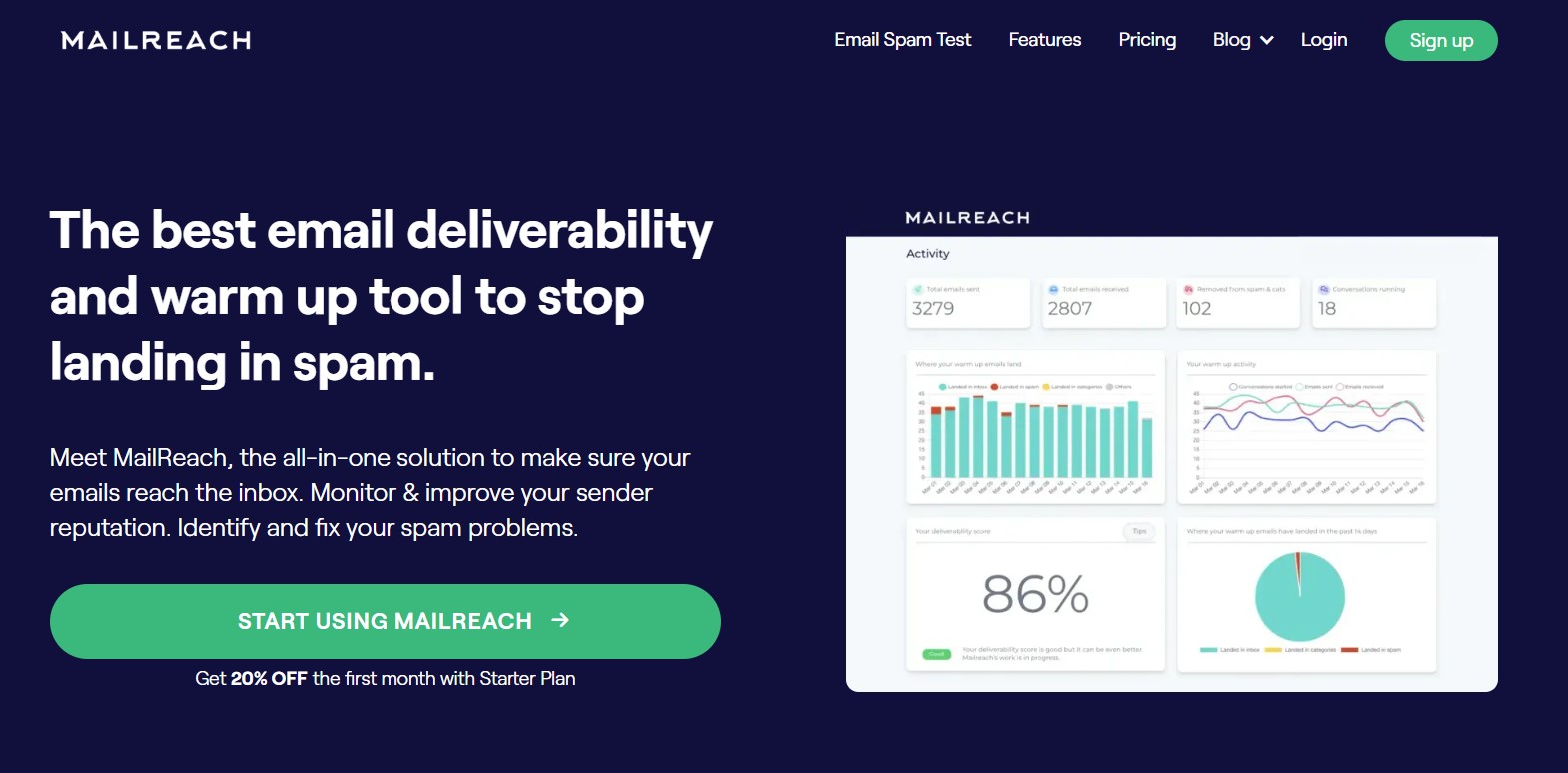
Not getting desired results from your email campaign?
Visualizing the ‘spam box landing’ challenge, particularly of small and medium businesses, Mailreach developed a unique approach of human touch in warm-up emails to begin a conversation in a realistic, natural tone that builds trust and passes the spam test.
As the conversation progresses, emails are automated and personalized based on inputs, resulting in a productivity boost and better lead conversion.
- The unique approach of solving spam-box landing challenge through a human approach;
- Reach inbox for better engagement, conversion, and productivity;
- Smart analytics to track performance;
- Better deliverability for better results.
HubSpot
If you are looking for a one-stop solution for your sales and marketing operations, HubSpot could be one of the preferred choices for email campaigns.
It offers you lead and pipeline management tools with synchronized emailing to boost operation efficiency and productivity.
Of course, the platform offers you all possible features that other popular platforms offer with the additional benefit of advanced analytics.
- Besides effective email marketing, it offers you integrated social media and Google Analytics in one location.
- Ease of use is one factor that makes it better
- Smart automation with options to personalize deliverability
- SEO-focused content for better contextualization and discoverability
Gist
It is pretty challenging to start and manage effective email campaigns, especially when you are short of time and energy and with a limited budget.
Gist offers you the ability to streamline marketing smartly through a full range of digital marketing tools and services.
You will be in full control of your email marketing campaign using Gist’s all-in-one email automation, analytics, and monitoring platform.
- Integrated chatbots for better real-time engagement with the audience for better conversion
- Highly efficient integrated sales and marketing approach for better productivity
- Message delivery timing automation for better response
There is no room for inefficiency in a modern, highly competitive market space, especially when engaging with the audience for the said purpose.
Whatever email marketing tools you opt for, you should keep the platform’s simplicity, security, segmentation, automation, analytics, and customer support in mind.
It is all about being wise and wanting to stay ahead of the competition using innovation.
Final Thoughts: Build an Email System You Won’t Have to Rebuild
The email platform you choose in 2027 isn’t just a tool for sending next Tuesday’s campaign.
You’re building infrastructure that may eventually contain years of customer history, automations, purchase data, segments, templates, integrations, and business knowledge.
That’s why some of the least exciting questions can become the most expensive ones later.
- Know what you actually own and can export. Subscriber data, consent records, customer attributes, campaign history, and suppression lists shouldn’t become trapped inside a platform you’ve outgrown.
- Calculate the cost at your future size. A tool that makes perfect sense at 1,000 subscribers may look very different at 50,000 once automation tiers, additional users, sending limits, SMS, and integrations are included.
- Understand your technical responsibility. If you’re asking should you host your business email server yourself, compare the additional control with the ongoing responsibility for security, authentication, reputation, uptime, maintenance, and deliverability. “Owning” more infrastructure isn’t automatically an advantage if your team doesn’t have the resources to operate it properly.
- Build automations around business logic you can explain. Looking at cart abandonment email examples can provide ideas, but document why each trigger, delay, message, and exit condition exists. Otherwise, years of accumulated automation can become a system nobody on the team fully understands.
- Plan for the possibility of switching. Choosing the MailChimp alternatives for smallbusiness email marketing becomes much easier when your data is organized, your integrations are documented, and your strategy isn’t dependent on one platform-specific feature.
This is where the real benefit of choosing email technology carefully appears.
You aren’t simply buying software.
You’re deciding how easily your customer communication can evolve when the business becomes larger, the team changes, prices increase, regulations develop, new channels appear, or today’s favorite platform no longer fits.
Nobody can predict which email tool will have the best AI features five years from now.
But you can build a system that gives your business the freedom to adapt when the answer changes.