How to Choose the Best Jewelry Manufacturer in Bangkok
✨Key Points
- Assess the complete manufacturing process: Look for design, modeling, stone selection, setting, finishing, and inspection capabilities rather than judging samples alone.
- Verify the materials: Request written details about diamond quality, gemstone treatments, metal purity, sourcing, and grading reports.
- Confirm commercial protections: Review prototypes, minimum orders, pricing, production timelines, warranties, and correction procedures before approving production.
Fine jewelry does more than complete an outfit.
It can express personal style, preserve family memories, represent cultural traditions, or give the wearer greater confidence on an important occasion.
However, the beauty visible in the finished piece depends on decisions made long before it reaches a jewelry box.
Choosing a jewellery manufacturer in Bangkok requires more than admiring a portfolio. Buyers should evaluate:
- Design and customization capabilities;
- Diamond and gemstone expertise;
- Manufacturing methods and quality controls;
- Metal purity and product specifications;
- Responsible sourcing documentation;
- Pricing, production capacity, and delivery terms;
- Repair, warranty, and after-sales policies;
Bangkok is an established international gemstone and jewelry center.
The Bangkok Gems & Jewelry Fair is recognized as one of the world’s major industry events, while Thailand is particularly significant in colored-gemstone trading and jewelry production.
This guide explains how skilled Bangkok manufacturers transform an idea into finished jewelry, and what buyers should verify before trusting a company with a valuable order.
Why Bangkok Jewelry Manufacturing Stands Out
Bangkok’s jewelry industry combines established handcrafting traditions with contemporary design and production technology.
Depending on the manufacturer, the process may involve:
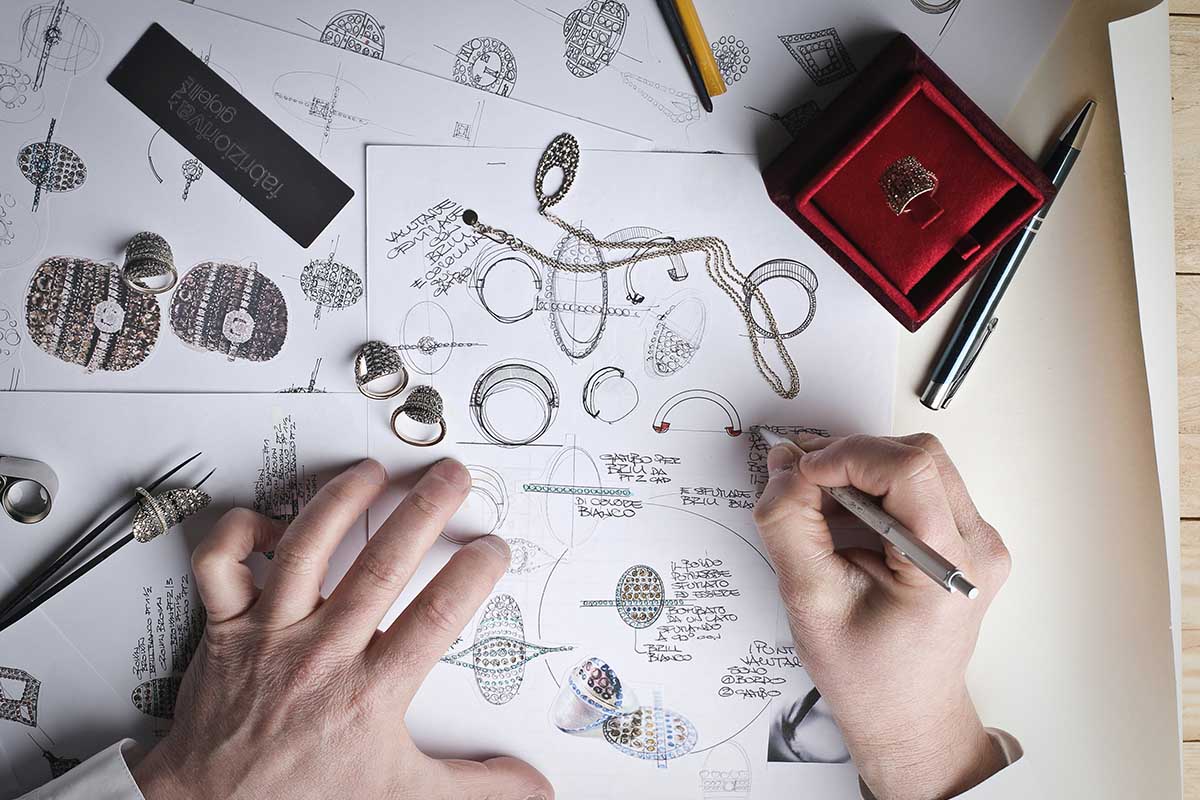
- Hand-drawn concepts and digital design;
- Computer-aided design and 3D modeling;
- Wax or resin prototypes;
- Casting in gold or platinum;
- Diamond and gemstone selection;
- Hand setting and joining;
- Polishing and finishing;
- Microscopic inspection and quality control.
Technology can improve consistency and precision, but it does not replace skilled judgment.
Experienced craftspeople must still assess proportions, secure stones, refine surfaces, and ensure the finished piece is comfortable and durable.
Experience and Transparent Expertise
A long operating history can indicate experience, but the number of years alone does not prove quality.
Buyers should ask what the team has produced, which markets it serves, and how its processes have evolved.
According to its website, Smart Arts Jewellery was established in Bangkok in 1999 and produces fine jewelry using diamonds, emeralds, rubies, and sapphires for brands, retailers, distributors, and private labels.
The company also states that it provides original design manufacturing and contract manufacturing services.
Before selecting any manufacturer, verify claims through:
- Recent product samples;
- Independent client references;
- Business registrations and industry memberships;
- Written material specifications;
- Factory audits or virtual production tours;
- Quality-control and sourcing documentation;
From Creative Concept to Finished Jewelry
A capable manufacturer should be able to explain every production stage clearly.
The typical process includes:
- Defining the design, materials, dimensions, and target price;
- Producing sketches or digital renderings;
- Creating and approving a prototype;
- Selecting diamonds, gemstones, and metal;
- Casting, assembling, and setting the piece;
- Polishing and completing the surface finish;
- Inspecting stone security, symmetry, measurements, and workmanship.
Request approval checkpoints before production begins.
Correcting a digital model is generally easier and less expensive than remaking a completed ring, necklace, bracelet, or pair of earrings.
Understanding Diamond Blemishes
Diamond blemishes are clarity characteristics located on a diamond’s surface, while inclusions are internal.
Their size, position, nature, visibility, and number can affect the clarity grade and sometimes the stone’s appearance or value.
Ask the manufacturer to disclose:
- The diamond’s clarity grade;
- Whether characteristics are visible without magnification;
- Whether any inclusion could affect durability;
- Whether the setting conceals or emphasizes a characteristic;
- Which independent grading report accompanies the center stone;
Not every small accent diamond receives an individual report. ;However, the manufacturer should still provide approximate color, clarity, carat weight, and quantity specifications for the stones used.
Are G Color Diamonds a Good Choice?
G color diamonds sit at the top of GIA’s near-colorless G–J range.
They can appear colorless to many viewers while generally costing less than D–F colorless diamonds.
Their appearance may be influenced by:
- Diamond shape and size.
- Cut quality.
- Setting metal.
- Surrounding accent stones.
- Viewing conditions.
Compare the diamond in the intended setting whenever possible.
A warm-colored metal may complement a broader range of diamond colors, while white metal can make subtle warmth more noticeable.
What Creates the Perfect Diamond Cut?
The perfect diamond cut is not simply a shape or a single set of measurements.
Cut quality concerns how effectively a diamond’s proportions, symmetry, and polish manage light to create brightness, fire, and scintillation.
For standard round brilliant diamonds, GIA assigns cut grades ranging from Excellent to Poor.
Fancy shapes require additional visual evaluation because GIA does not apply the same overall cut-grade system to every shape.
When comparing diamonds, examine:
- Brightness and contrast;
- Sparkle during movement;
- Symmetry and polish;
- Windowing or dark areas;
- Face-up dimensions;
- Girdle thickness and durability;
A larger diamond with weak proportions may look less attractive than a smaller, better-cut stone.
Where to Find the Best Diamond Rings
Buyers researching where to find the best diamond rings should define “best” according to their needs.
A ring may be valuable because of its craftsmanship, originality, durability, diamond quality, customization, or emotional meaning—not merely its carat weight.
Compare manufacturers by asking:
- Can the design be customized?
- Who selects and grades the stones?
- Is a prototype included?
- Which laboratory issues the diamond report?
- What happens if the finished piece differs from the approved design?
- Are repairs, resizing, and replacement stones available?
- Will the manufacturer provide a detailed invoice and product specifications?
These questions are particularly important for retailers, jewelry brands, and private-label buyers placing repeat or high-volume orders.
Jewelry as Personal and Cultural Expression
Jewelry can communicate identity as strongly as clothing, hairstyle, or tattoo designs for men and women.
Custom production allows buyers to translate personal symbols, historical references, architecture, or cultural motifs into wearable form.
Bangkok itself can provide creative inspiration through its art, heritage, and institutions.
Visiting a museum in Bangkok may help designers understand local stories and visual traditions.
Cultural elements should be researched and used respectfully rather than copied without context.
Final Thoughts
The best Bangkok jewelry manufacturer is not necessarily the company offering the lowest quote or the most elaborate samples.
It is the one capable of translating an approved design into a consistent, secure, and properly documented finished piece.
Before ordering:
- Examine recent work closely;
- Verify diamond and gemstone information;
- Approve designs and prototypes in writing;
- Confirm metal purity and finished dimensions;
- Understand pricing, timelines, and minimum quantities;
- Review correction, warranty, and after-sales terms.
The final piece should do more than attract attention.
It should reflect the wearer’s identity, withstand its intended use, and preserve the quality of its materials and craftsmanship for years.